Quality Concerns Remain as States Invest More Than Ever in Preschool Programs
April 30, 2026

nipastock/Shutterstock
More four-year-olds are enrolled in state-funded preschools than ever before, but the quality and availability of preschool programs have experts concerned about creating a system of haves and have-nots.
“If providing high-quality preschool education to all 3- and 4-year-olds were a race, some states are nearing the finish line, others have stumbled and fallen behind, and a few have yet to leave the starting line,” an annual report from the National Institute of Early Education Research states.
With the amount of funding and quality varying by state, it means that access for families in states that aren't investing still widely varies.
The report, titled “State of Preschool: 2025 Yearbook,” breaks down the annual spending, quality and enrollment numbers across early childhood education programs in the U.S. The latest found states hit an all-time high for both spending and enrollment, but the quality of the programs remains a concern.
“We’re trying to make sure states are also thinking about quality,” Allison Friedman-Krauss, an associate research professor at NIEER, says. “Right now, it’s more about access. And we don't want them to forget about quality.”
More Funding – But Not Always More Quality
The report found funding peaked at nearly $14.4 billion, though that was largely driven by a handful of states: $4.1 billion in California alone, along with $1.2 billion in New Jersey and $1 billion in New York. Those three states accounted for nearly half (45 percent) of all state pre-K spending.
More than two dozen states also increased their preschool spending, which can go toward things like improving teacher-to-student rations and improving teacher compensation, the latter which has long been a concern.
While states still increased their spending on pre-K this year, the rate at which states are investing is slowing down. Adjusted for inflation, each state spent an average of $45 more per child than the 2023-2024 year. However, last year’s increase in spending was 16 times as large.
New Jersey, Oregon and the District of Columbia gave more than $15,000 in state funding per child enrolled in preschool. Six other states (California, Connecticut, Delaware, Michigan, New Mexico, and Washington) spent more than $10,000 per child enrolled in pre-K. Twenty eight states overall spent more funding per child, adjusted for inflation, than past years.
NEWSLETTERS
STAY AHEAD IN EDUCATION.
Sign up for EdSurge newsletters for timely news, insights and analysis.
Seventeen states spent less on preschool in 2024-2025 than they did in 2023-2024, when adjusted for inflation. The researchers attributed the spending decline in part to overall state deficits and falling enrollment across many states.
However, that’s not always the case. New Jersey had a budget deficit but invested an additional $100 million into expanding preschool programs for all.
Pointing toward this, Steve Barnett, director of NIEER, argues that it’s all about state priorities: “That’s a conscious decision to say we’re going to spend less,” he says. “And you have to ask if the declining enrollment – even if not intentional – is a way to reduce spending [in the sector]. As opposed to, ‘Maybe we should work on getting parents to enroll their kid.’”
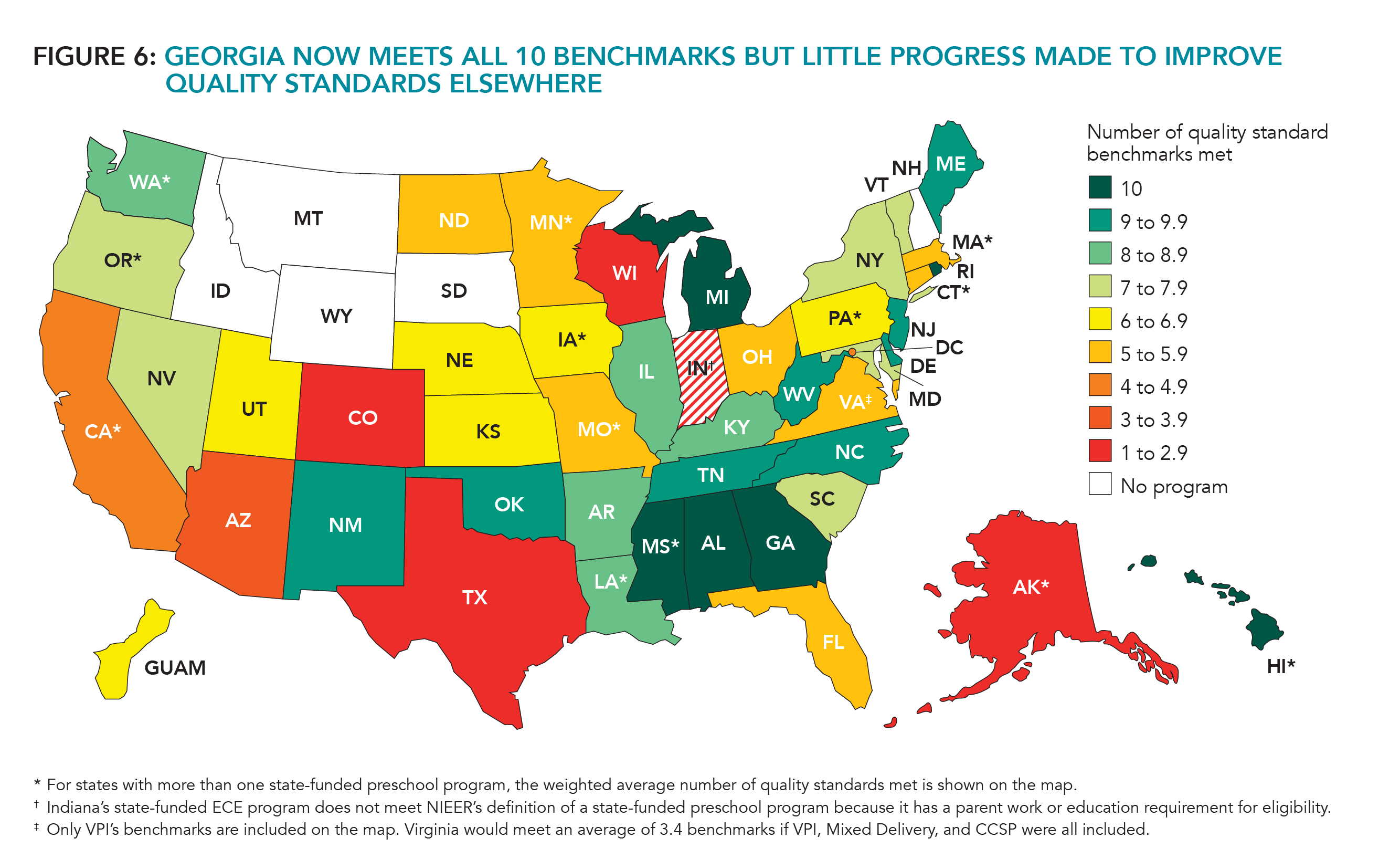
The boost in funding did not always correlate to better early childhood education programs. Only six states met all of NIEER’s 10 quality standards benchmarks, which includes a maximum class size of 20 students, a requirement that teachers have bachelor’s degrees and a classroom ratio of at least one staff member for every 10 students.
States looking to enhance preschool quality should focus on class size and teacher pay, Barnett argues.
Teacher pay and class sizes account for most of the money, and once states have improved those, other metrics, like curriculum supports and health screenings, are easier to pay for later, he adds.
But changes won’t happen overnight.
“It does take time. You can’t just wave a magic wand and have classroom size and teachers’ pay magically fixed,” Barnett says.
NIEER's Friedman-Krauss, pointed to Alabama and Georgia as examples of slowly, but surely, increasing preschool quality. Georgia hit all 10 quality benchmarks this year. Friedman-Krauss credits the improvement to a $97.6 million investment by the state, which helped lower classroom size from 22 to 20 and increased teacher pay.
“We make a big deal of it because it’s serving most of the 4-year-old [children] and hitting all the benchmarks,” Barnett says. “It’s a state that lost them and came back even stronger; that’s a good sign.”
Lion’s Share of Enrollment Only in a Few States
Enrollment, similarly to funding, reached an all-time high nationally last year, with 1.8 million children during the 2024-2025 school year. But roughly half of that comes from four states: California, Texas, New York and Florida.
Notably, a dozen states had more than half of their four-year-olds in state-funded preschool programs, with the District of Columbia topping the list: 94 percent of four-year-olds were enrolled in their state programs. California’s enrollment gains were buoyed in part due to the state’s universal pre-K promise.
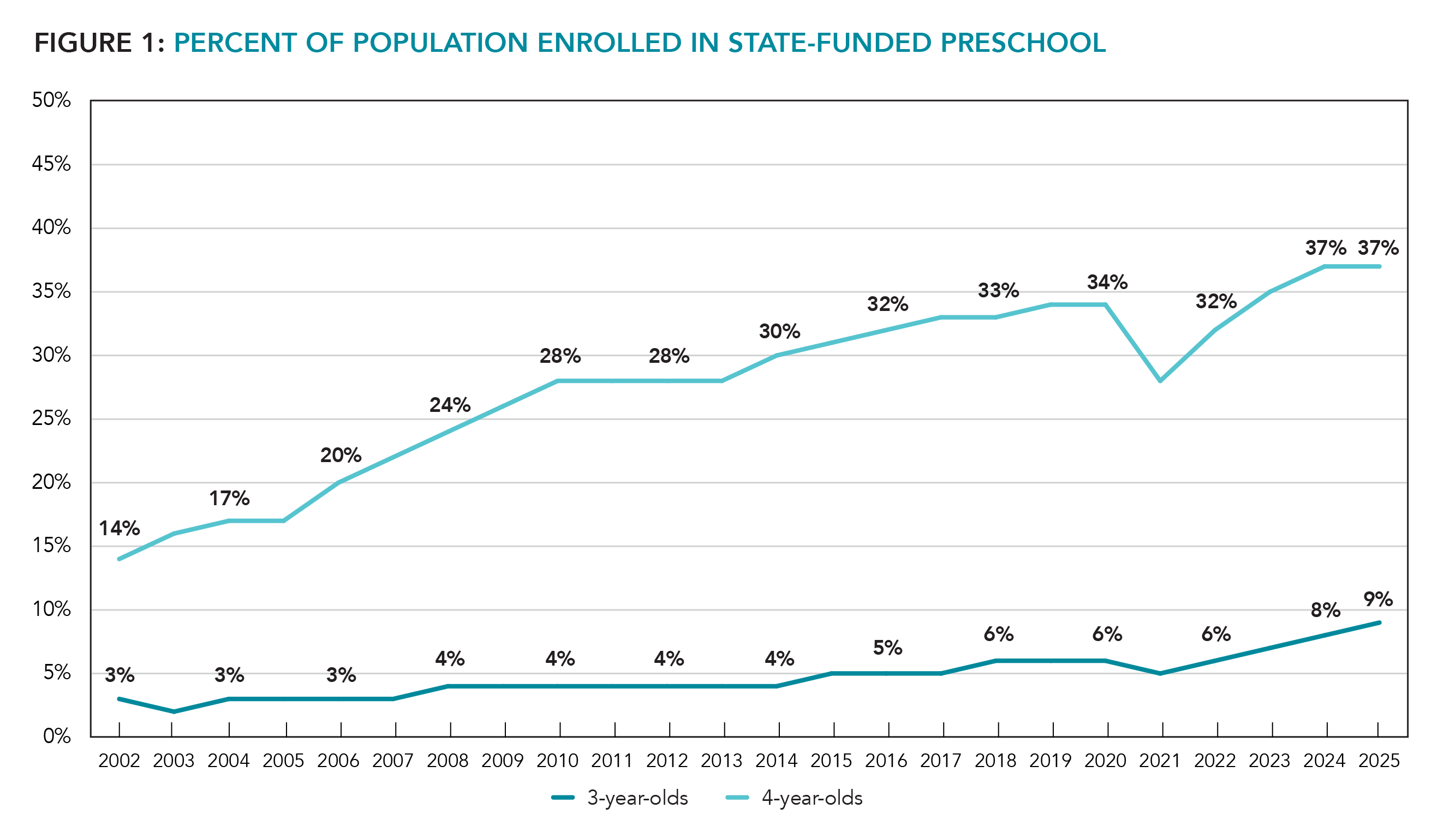
However, twenty states enrolled fewer preschoolers in 2024-2025 than the prior year. Some could blame the dip on declining birth rates. But when adjusted by population percentage, 21 states still saw a dip.
For some states, the enrollment decline was steep. Indeed, six states (Arizona, Florida, New York, Ohio, Oklahoma, and Wisconsin) decreased enrollment by more than 1,000 children.
Three-year-old students made up only 9 percent enrollment across the nation, up from 5 percent a decade earlier. Some states are acting to counter this. For example, Illinois and New Jersey are both focusing on expanding preschool programs for three-year-olds, Friedman-Krauss says. However, she and Barnett expect a slow mass adoption of three-year-olds in state-funded programs.
“I think there will be more attention paid to that group – how much more, that’s the hard part,” Barnett says. “Nine percent is better than when we started, but it’s very lumpy. It’s still 0 percent in lots of places.”
Lauren Coffey (@Lauren__Coffey) is a reporter at EdSurge covering early childhood education and technology at the K-12 level.
Popular on Edsurge
News
Hundreds of Thousands of Eligible Kids Are Waiting for Childcare Assistance
Moriah Balingit and Lauren CoffeyNews
A Principal and a Student Reviewed the New ChatGPT for Teens. They Had Plenty to Say
David WeldonRead Next




Admissions Scandal, Painful Pivots and Other Themes From ASU GSV