How My School Used Common Sense and Collaboration to Confront AI
What I learned navigating a policy vacuum as a tech coordinator and the collaborative process to build an AI-ready culture.
July 15, 2026
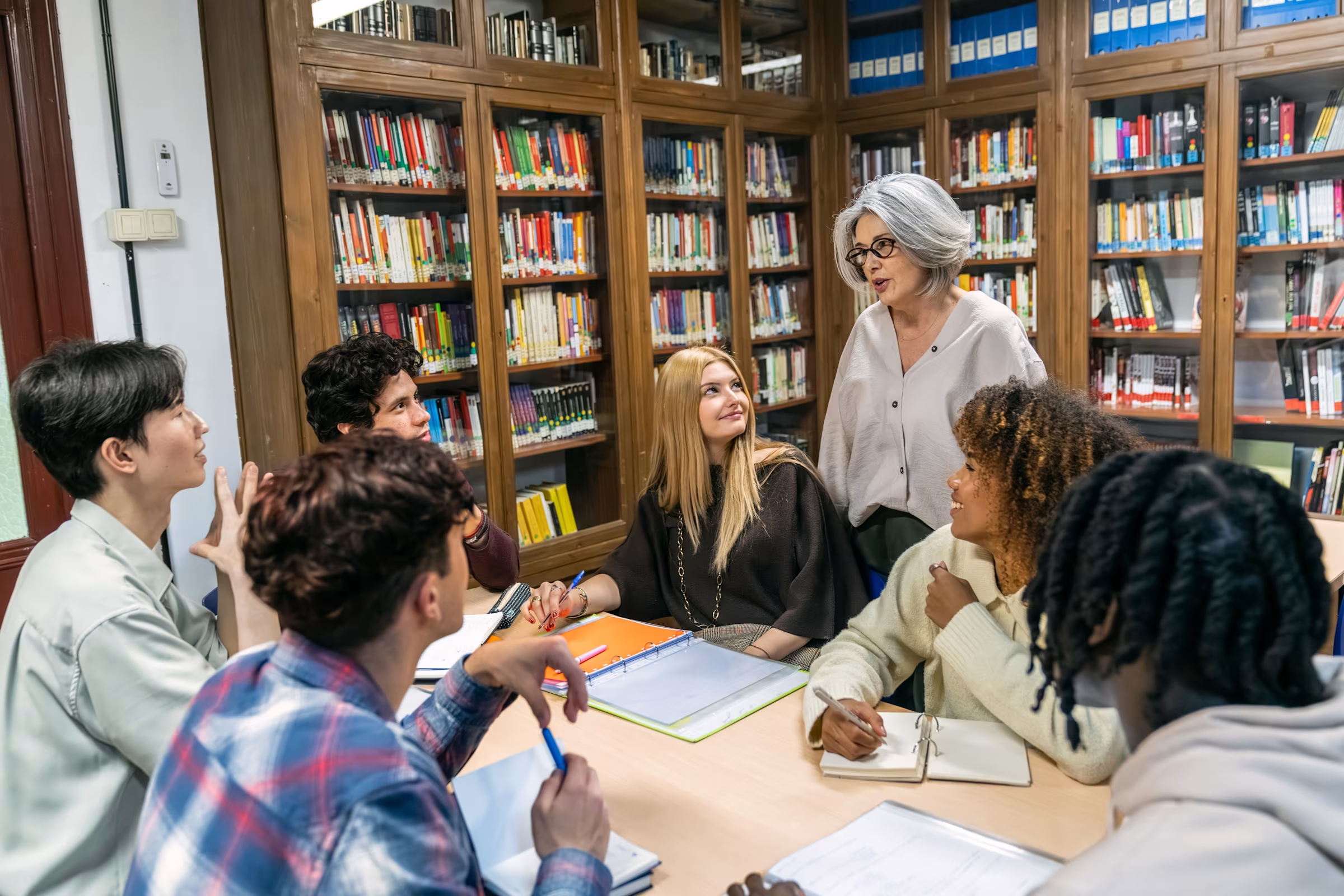
koldo_studio / Shutterstock
We’ve all had some version of the nightmare: You’ve been inexplicably thrown back into high school, and now you’re standing in front of the class. You’re about to give a speech, but you can’t remember a word. The panic is exacerbated by the faces of students staring at you, some hiding snickers and others openly laughing. Everyone knows what’s going on but you.
I was reminded of this bad dream over the past few years. As my Indigenous school’s instructional technology coordinator, I have seen my office transform from a routine integration hub into a digital confessional. Colleagues and teachers who are trying to navigate destabilizing technology changes slip inside and close the door. Some are looking for practical technology triage, or just a safe space to vent their frustrations, only to recount a similar nightmare.
For these educators, the experience triggers a sharp wave of panic, a sudden realization that the pedagogical ground has shifted beneath their feet and they can no longer trust their own instincts or traditional technology guardrails. But what follows the panic is a deep, stinging embarrassment.
With open and hopeful hearts, these teachers publicly praised student writing, extolling the hard work and growth they believed the student had demonstrated, only to find themselves surrounded by the giggles of classmates who already knew the truth: the writing had been fully generated by an AI tool.
The students had technically succeeded while learning very little, a phenomenon Micah Miner describes as unproductive success in “Beyond Secondary Orality.” As a result, teachers and administrators are left trying to respond to tools and behaviors they don’t yet fully understand and have never been trained to address.
These individual instances of unproductive success were not isolated classroom frustrations; they were early signals of a policy vacuum that would soon overwhelm our entire school system. The challenge becomes infinitely more complex at the school board level, where drafting a formal policy requires balancing the inevitable push toward AI integration with the deeply nuanced and often conflicting perspectives around AI held among students and families in the Native community. Before an AI policy could establish clear lines of accountability for staff and students and safeguard Indigenous data sovereignty, students were already using AI tools outside the school day to engage in cognitive offloading, having essays written for them.
Because neither an official AI policy nor an academic honesty policy existed, teachers and administrators were forced into the uncomfortable position of responding to what many perceived as cheating without the guidance, definitions or training necessary to do so consistently.
The problem wasn’t just that students discovered AI before adults did; it was an economy-of-scale issue. Being a one-person technology department meant that the burden of finding a solution and making high-level policy recommendations rested entirely on me. No matter how urgent the crisis, a lone coordinator cannot instantly scale the resources an entire school community needs to decide what AI means, how it should be used, or how we should teach students to navigate it responsibly.
Schools often rely on common sense, hoping that everyone will land on the same understanding. Unfortunately for us, AI has exposed an uncomfortable truth: common sense is often just unspoken assumptions masquerading as policy. Without a common understanding of AI use, implementation practices, potential risks and benefits, schools risk creating inconsistent and inequitable experiences for both students and educators. This raises the question: who decides what is reasonable or what makes a decision good?
Answering that question didn’t require finding a perfect, pre-packaged solution. Ultimately, it required a small but dedicated team of school leaders, educators and me to build one from the ground up.
Building a Framework on Common Sense and Community
For the past several years, it has been my job to learn as much as I can to create our own AI common sense, one based on the mission of our school to prepare our students to carry forward the wisdom of our ancestors for the benefit of future generations.
My first step was to seek out as much information as possible from trusted sources. This led me to the International Society for Transforming Education and their AI Explorations course, which established my foundational knowledge around AI and machine learning and created a strong network of other professionals who were also trying to navigate without a map.
My second step was to reach out to my school’s stakeholders to ensure the work on AI benefited from as many diverse perspectives as possible. As a new instructional technology coordinator in 2017, one of the first things I did when establishing my program at Indian Community School was to create a Future Ready Team, a cross-functional group of teachers, IT and administrators.
These Future Ready Team members became the resident experts during their two-year terms, learning to communicate with vendors and piloting new software and devices. When the issue of AI policy arose, it was this team that rose to the challenge and continued the research process along with me.
After months of research and collaboration with the Future Ready Team, my binder was overflowing with highlighted articles, ideas, notes and guidance documents — proof that some habits from my 1990s school days die hard — while my computer held an equally overwhelming collection of bookmarked tabs.
Faced with this data overload, I knew my job was to translate this research into action. The solid footing we needed was a comprehensive AI framework, so I took the lead on designing a model that would serve as a strong foundation for building knowledge and be flexible enough to adapt to the ever-changing AI landscape.
I personally curated and authored each layer of this framework to meet our school’s specific needs. This included a core policy I developed using resources from the U.S. Department of Education, UNESCO, the Publications office of the European Union and the Wisconsin Department of Public Instruction. I also drafted staff AI guidance based on the AI Guidance for Schools Toolkit by TeachAI, revamped our student responsible use policy to incorporate AI guardrails and constructed a visual stoplight of AI usage for classrooms based on the work done in our home state of North Carolina.
The framework also needed to do more than establish expectations; it needed to support educators in meeting them by addressing critical issues such as safeguarding personally identifiable information, protecting intellectual property and honoring Indigenous data sovereignty.
Policies Can’t Teach People
While these protocols were a necessary first step in securing our digital environment, a framework is only as effective as the people implementing it. Creating the policy and guidance documents was only part of the work; true equity emerges in a school community’s capacity to respond, specifically having the staff, training, time and funding needed to translate policy into practice.
Knowing that even the best guidance will sit unused without these resources, we ensured our framework went beyond rules to provide active opportunities for people to learn, question and build understanding together.
Before students were given access to AI tools on school devices, staff engaged in professional development designed to build AI literacy and confidence. Learning opportunities continued through local and state conferences, while families and community members were invited to join the conversation at an AI literacy night. The goal was not simply to introduce a new technology, but to build a shared foundation for its responsible use. The outcomes of this collective effort extended far beyond compliance.
Teachers who had previously felt overwhelmed by the sudden influx of these tools gained the confidence needed to navigate them, shifting their approach from policing technology to guiding its purposeful use.
Similarly, our engagement with families provided parents and community members with a transparent look at what AI usage actually looks like in classrooms. This shared clarity transformed potential anxiety into partnership, ensuring the entire school community was aligned around a unified approach that protects student critical thinking while fostering academic readiness.
Enduring Understandings Benefit All
Ultimately, this journey has taught me that AI common sense isn’t something we can simply mandate or print out. It isn’t found neatly tucked inside a binder, no matter how many national frameworks we compile. True common sense has to be built intentionally through the collaborative and sometimes uncomfortable work of research, reflection and learning alongside one another.
While a policy can draw the lines on a map, it is the shared knowledge and trust within a school community that actually gives us the solid footing to move forward.
At Indian Community School, that forward path is always guided by the principle of thinking seven generations ahead. It is a grounding reminder that the choices we make today about AI are not just about managing next week’s essays or updating a student handbook. They are about shaping students' learning habits and critical thinking abilities long after they leave us.
For schools everywhere, the challenge now is to look past the establishment of compliance. We must close our binders, sit down with our communities and commit to the slower, more deliberate work of building shared understanding around AI. We have to stop racing to build rules and instead start investing in the training, time and relationships that ground our educators for whatever comes next.
This story is part of an EdSurge series chronicling educator experiences. These stories are made publicly available with support from Learning Commons. EdSurge maintains editorial control over all content. (Read our ethics statement here.) This work is licensed under a CC BY-NC-ND 4.0.
Popular on EdSurge
Read Next


News
EdSurge Podcast
Putting Edtech Guidance to Work in the Classroom

News
EdSurge Podcast
Why Do So Many Teachers Crash in October?

News
Childcare
Hundreds of Thousands of Eligible Kids Are Waiting for Childcare Assistance

Voices of Change
Coding
How Coding Can Cultivate Deep Civic Engagement

News
Attendance