Do Active-Shooter Drills in Schools Do More Harm Than Good?
By Jeffrey R. Young and Nadia Tamez-Robledo
February 28, 2023
Kate Way / Shutterstock
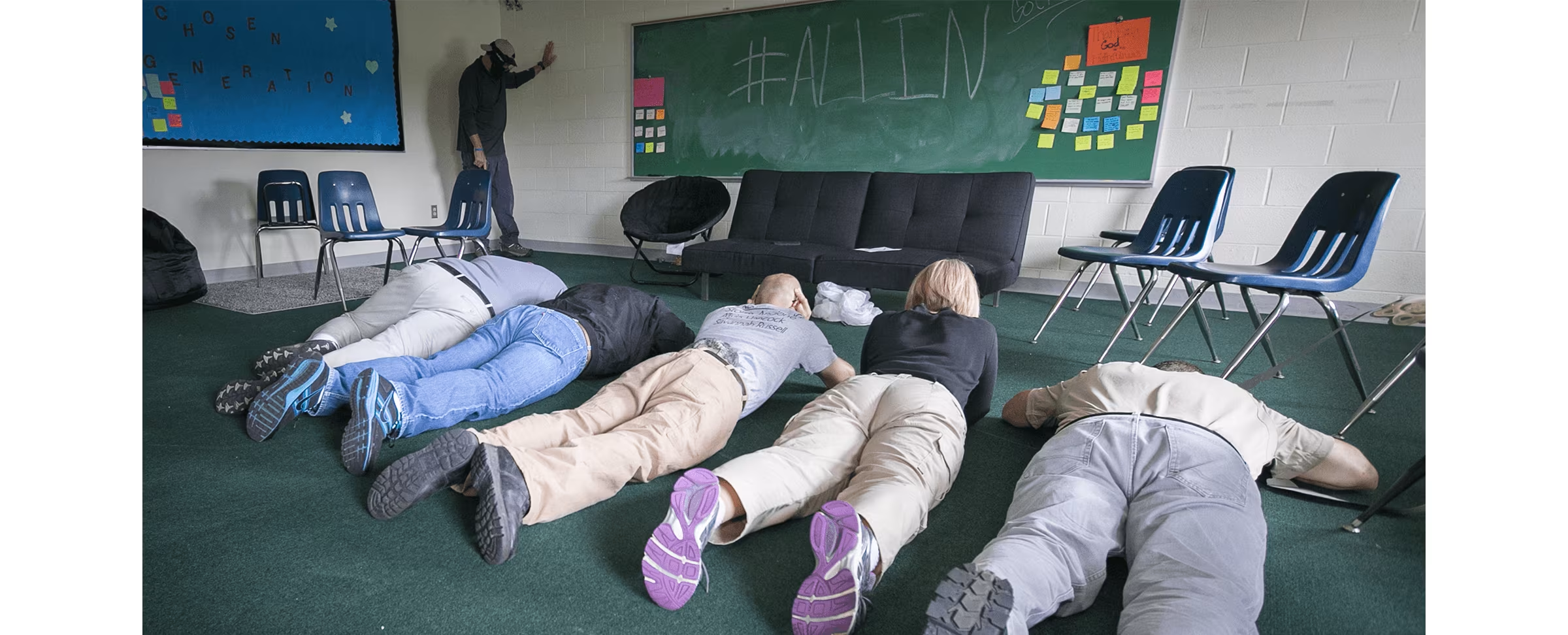
School employees play dead on the floor during an active shooter mock scenario.
Donna Provencher, a freelance journalist near San Antonio, was folding laundry last week when her 8-year-old son made a comment that stopped her cold.



“He said, ‘Mom, do you remember when the shooter came to my school?’” she recalls.
There hadn’t been a shooting. But the second grader had gone through an active-shooter drill at his school, where he was instructed to curl up in a ball on the classroom floor.
And for him, the experience seemed all too real, as he had misunderstood the situation as a real shooting rather than a simulation.
"‘That was just a DRILL?’ he said, incredulous. ‘I thought we were actually going to die,’” his mom remembers.
Provencher shared the moment on Twitter last week, and it went viral, with nearly 2 million views.
In an interview with EdSurge, Provencher noted that her son, who she describes as “neurodivergent,” is prone to taking things literally. He has ADHD, she said, and is being evaluated for possibly being autistic. But when her tweet went out, she said she was surprised by how people shared similar experiences.
“Something that was a really common thread was older students who said they had the exact same experience in middle school or high school, where for 20 minutes, they thought they were dying, and they were texting their goodbyes to their parents, and then it turned out to be just a drill,” she says.
A study published in the journal Nature in 2021 analyzed millions of social media posts by students before and after active-shooter drills and found that anxiety, stress and depression increased by 39 to 42 percent following the drills. The research did find benefits of the activities as well, with a significant boost in feelings of solidarity with classmates and civic engagement.
NEWSLETTERS
STAY AHEAD IN EDUCATION.
Sign up for EdSurge newsletters for timely news, insights and analysis.
But some groups are now questioning whether the benefits are worth the psychological downsides to students.
Provencher has since called the school and asked them to let her know if they ever do another drill, so she can keep her son home that day. And that’s something more parents are asking for as well.
In Maryland, for instance, a group of lawmakers recently proposed a bill that would require school systems to tell teachers and parents ahead of time about any active-shooter drill. The measure was proposed by a legislator who is a former teacher, who points out that when schools have other safety drills, including fire drills, they don’t pretend there’s really a fire or other emergency. But with active-shooter drills, he says, students are often asked to pretend a shooter is actually in the building.
Opponents of the bill, however, say it’s important for students today to go through such simulations so they will know how to best respond if a shooter does come to a school.
Colleges, too, now routinely hold active-shooter drills. Just last week, an EdSurge reporter attended a “situational awareness” drill at the University of Houston–Downtown, where, as she described in an essay, participants learned how to tie a tourniquet to stop the bleeding from a gunshot wound, were shown the best way to disarm someone holding a pistol and were taught to always be aware of where the nearest exit is. It left her asking, “What kind of bizarro world are we living in where this is a normal, maybe even essential, part of education?”
For this week’s EdSurge Podcast, we dive into this issue, and talk to a professor who has done a meta-analysis of strategies aimed at preventing school shootings, William Jeynes. He is a professor of education at California State University, Long Beach and author of the book, “Reducing School Shootings.”
Listen to the episode on Apple Podcasts, Overcast, Spotify, Stitcher or wherever you get your podcasts, or use the player on this page.
Jeffrey R. Young (@jryoung) is producer and host of the EdSurge Podcast and the editor of EdSurge. He can be reached at jeff [at] edsurge [dot] com
Nadia Tamez-Robledo (@nadiatamezr) is a reporter for EdSurge.
Popular on Edsurge
News
Hundreds of Thousands of Eligible Kids Are Waiting for Childcare Assistance
Moriah Balingit and Lauren CoffeyNews
A Principal and a Student Reviewed the New ChatGPT for Teens. They Had Plenty to Say
David WeldonRead Next

The Big, Big Problem with Current K-12 Investing




Opinion
Teaching and Learning
How Do You Make Zoom Breakout Rooms Less Boring?