Report: School IT Officials Worried About AI Adoption, Cybersecurity
June 2, 2026
Allison Shelley/EDUimages
While schools have made progress in technology adoption — from artificial intelligence guidelines to vetting education technology — they still struggle with the lack of resources, funding and expertise, according to a new report.
The annual State of EdTech report from the Consortium for School Networking polled roughly 600 chief technology officers for K-12 schools. One of the biggest takeaways, according to CoSN CEO Keith Krueger: AI adoption is higher than ever. According to the report, nearly three-quarters (79%) of school districts have AI guidelines in place, up from 57% in 2025.
“Given how many school districts we have, given how many small and rural ones there are, it’s shocking at how quickly at least the guidance around responsible use of AI is,” Krueger says. “As a foundational step, we’re seeing movement.”
But respondents repeatedly stated they are running into roadblocks of insufficient staffing and funding.
“There’s never going to be enough training, and we have to make sure the training is quality and meeting administrators with what they want and need,” Krueger says, adding it’s not just about training on a specific tool, but “helping them think in new ways how to use the tools.”
Most of the districts polled are in favor of AI guidelines, either set by the districts themselves or state education agencies, but do not want state or federal mandates. Typically, mandates are formed, then approved, by a board — something that is time-consuming and does not lend itself well in the fast-moving world of AI.
“This week, this month, this year is changing rapidly,” Krueger says. “It doesn’t mean we change fundamental beliefs of what’s cheating (with AI), for example, but things are moving rapidly. You don’t want to have too many solidly, board-approved things which can get locked in when you need to evolve.”
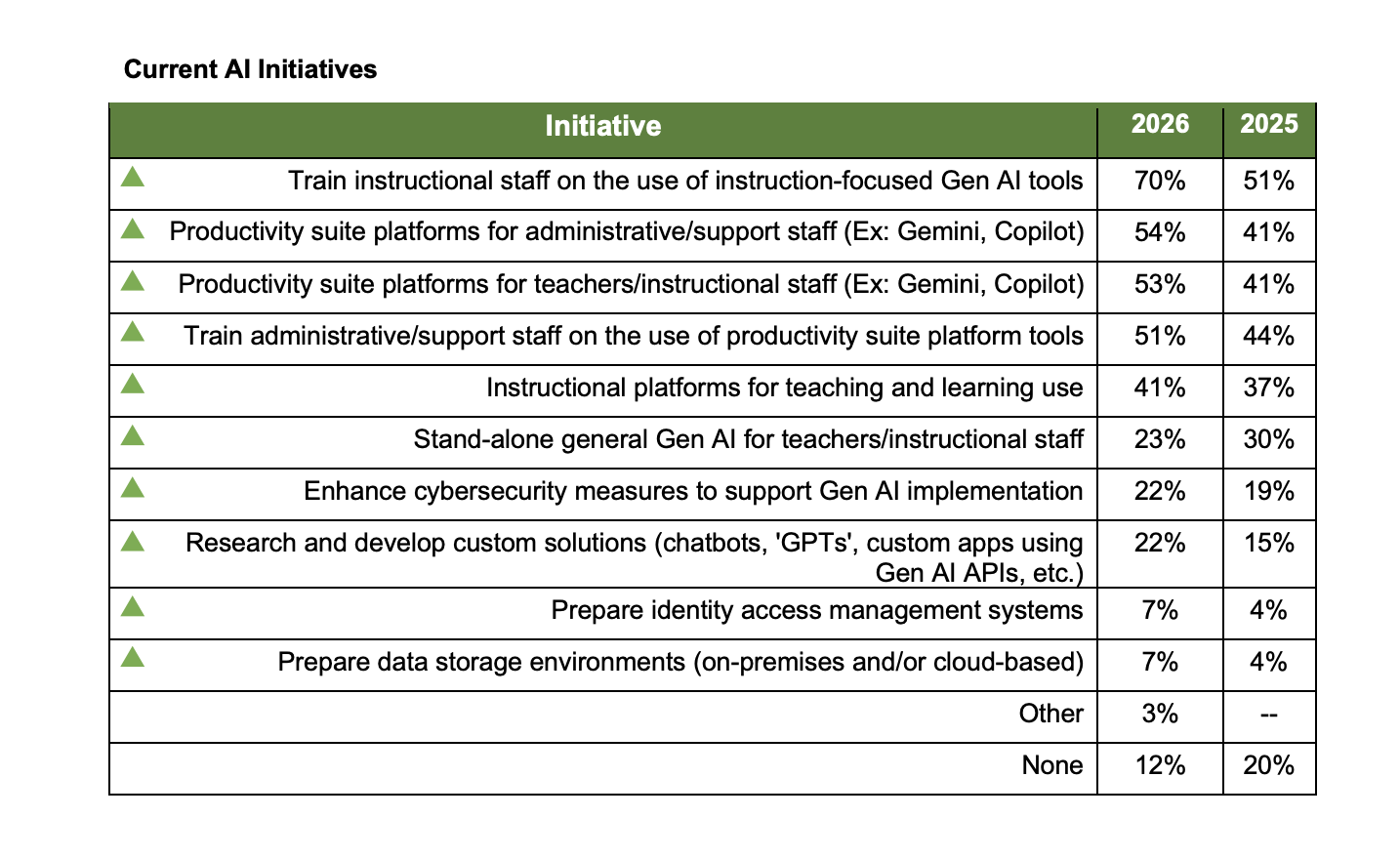
The most common AI initiative among districts is training staff on the use of instruction-focused generative AI tools, with 7 out of 10 respondents saying they do so. Productivity-focused measures focused on instructional staff and teachers followed, with 54% and 53%, respectively, deploying those initiatives. One of the largest jumps was the amount of districts having initiatives focused on AI’s operational purposes, from 37% in 2025, to 64% in 2026.
Less than half (41%) of initiatives focus on using AI for teaching and learning.
NEWSLETTERS
STAY AHEAD IN EDUCATION.
Sign up for EdSurge newsletters for timely news, insights and analysis.
“I would say the low hanging fruit is on the operational and teacher productivity side,” Krueger says. “We should continue to explore and think through the great uses that are in the classroom. But, overnight we shouldn’t just wildly go trying to do those things when it's going to take time to figure out the instructional piece.”
Cybersecurity
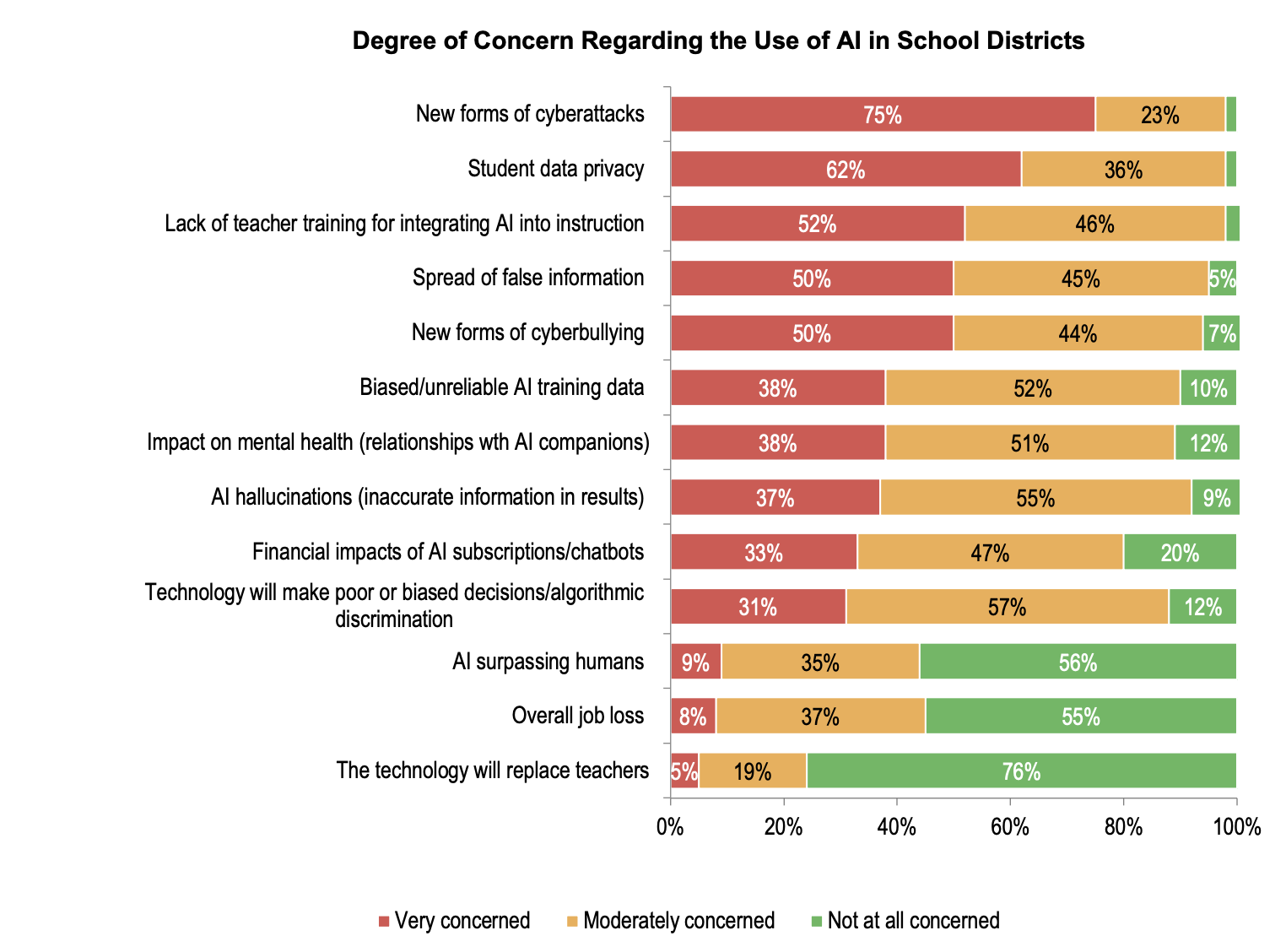
The largest concern about AI use: cybersecurity attacks. According to the report, nearly all respondents (98%) are concerned that AI can bring in new forms of cyber attacks, with just 2% stating they are “not at all concerned.” That same percentage also has concerns on student data and AI’s effect on its privacy.
While the concern over cybersecurity is strong, two-thirds of respondents state they have insufficient staffing and budget to address those challenges.
Cybersecurity concerns continue to cause schools woe, most recently with the Instructure attack in May that caused several schools to pay a ransom and shut down one of the world’s largest digital education platforms.
“The high visibility breaches and attacks that we’ve seen underscore the real cost to our school system by not investing in better cybersecurity,” Krueger says.
After 17 years of utilizing the State of EdTech report, Krueger says he believes a tipping point may have finally been reached on addressing cyber concerns.
“Certainly those in charge of technology have been yelling loudly that cybersecurity is a problem,” he says, adding the issue has become more well-known among superintendents and school board members. “I think they will start to say, ‘We can’t just have these broadband networks and not have them safe and secure.’ But it’s a huge challenge, given the lack of human capacity in schools for cybersecurity.”
EdTech
Another major finding from the report is an issue that has been bubbling beneath the surface in both tech evangelist and oppositional circles: vetting educational technology.
Edtech vetting has been under consideration amid the screen-time backlash in classrooms, with some states pushing for better review of the vetting process. Oftentimes, schools rely on the vendors’ own data and are unequipped to review the software themselves to ensure children’s safety.
“There is nobody right now that is confirming these products are safe, effective and legal,” Kim Whitman, co-lead for Smartphone Free Childhood US, said in a previous interview with EdSurge. “It should not fall on the district’s IT director; it would be impossible for them to do it. And the companies should not be tasked with doing it — that would be like nicotine companies vetting their own cigarettes.”
According to the report, most schools now have a process for vetting free edtech tools before they’re used in schools, either through IT or a list of approved vendors.
But that process still has some gaps: only 29 percent require information about if the product is inclusive and accessible for all learners. That is particularly worrisome for accessibility advocates who already fear they are being left out of the conversation.
“Parents with children who have a disability must have a seat at the table,” Sambhavi Chandrashekar, global accessibility lead for D2L, an online learning platform, said in a previous EdSurge interview. “Blanket rules that are blind to fundamental human differences will do more disservice than good to students at the margins.”
And while more than half (55%) of the edtech processes require vendors to provide information about safety, that leaves roughly 45% not addressing safety concerns.
“It’s a huge warning sign; there’s a whole lot of progress and work that has to happen in this area,” Krueger says.
He suggested reviewing the five quality indicators for edtech and AI products, with districts benchmarking their current status and set it as a priority to push forward.
“One of the biggest powers we have is procurement, so getting serious about how we buy them, and when,” Krueger says. “Whether or not we move forward will depend on if we set it as a priority and get serious about the awareness, the training and the policies.”
Popular on EdSurge
Read Next




News
Higher Education
Early Childhood Educators Are Leveling Up at Community Colleges


News
Visual Arts


Voices of Change
Artificial Intelligence