Lawsuits Test New Legal Theories About What Causes Social Media Addiction
School districts are among a wave of plaintiffs who claim that the platforms’ design, not the content, poses the real threat to kids’ mental health.
February 17, 2026
Paper Trident / Shutterstock
A high-stakes trial sparked by a California woman who first logged onto social media at age 10. Another lawsuit in Georgia filed by a school district despairing at distracted students. Dozens more legal actions brought by state attorneys general accusing digital platforms of playing mindgames with children.
These are among thousands of lawsuits filed against social media companies with the claim that they purposely designed their apps to be addictive to young users, causing mental health harm and interfering with their education in the pursuit of profit.
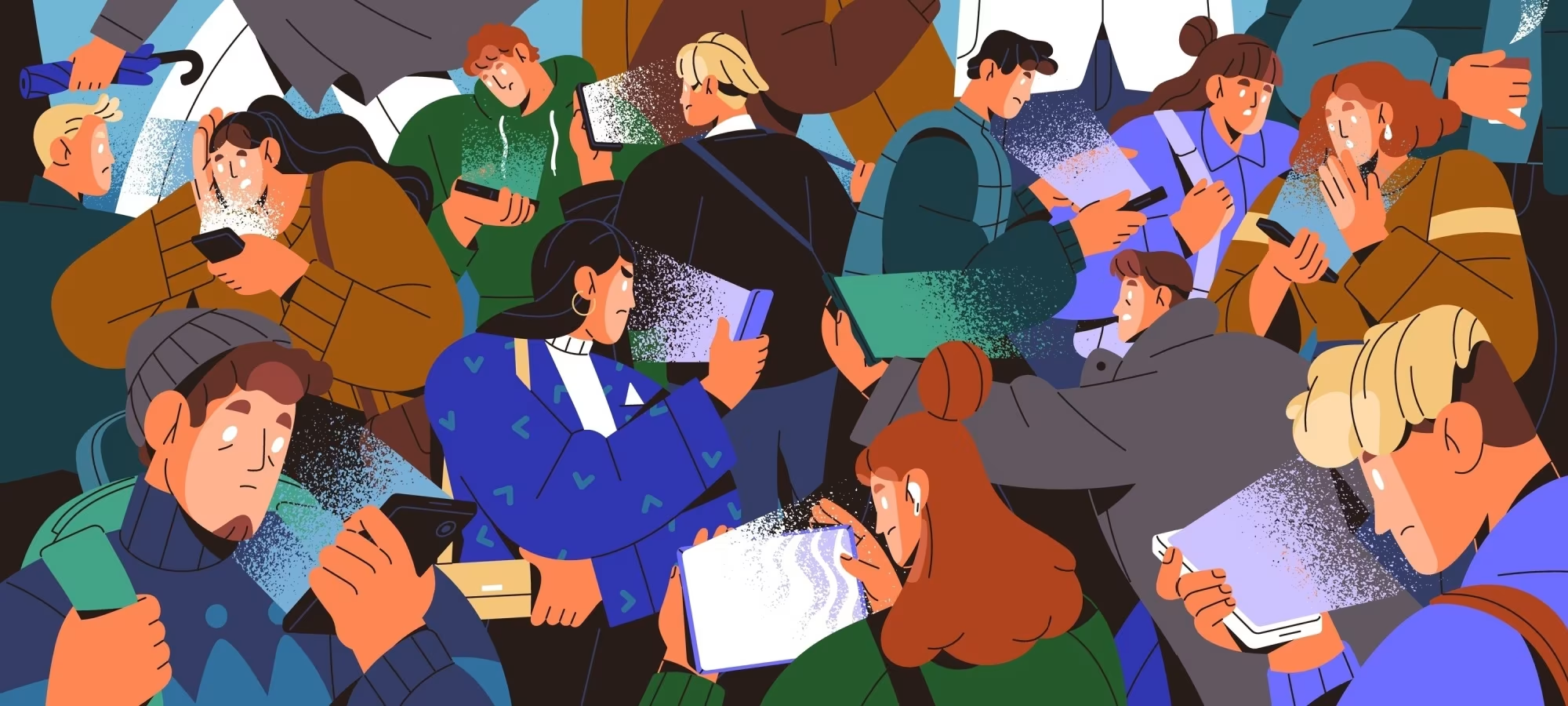
Plaintiffs in these cases are pursuing a new legal strategy: they’re claiming that it’s the design of social media platforms — not the content — that is leading to harm.
This month, the first case to go to trial will test the strength of that theory and shape how thousands of other lawsuits against social media companies are argued.
The trial comes at a time when schools find themselves on the frontlines of an ongoing youth mental health crisis that accelerated during the pandemic.
Child online safety advocates have told EdSurge that while they’ve been sounding the alarm on the harms that children face online, there hasn’t been meaningful change from social media platforms. Educators have long been frustrated over shrinking attention spans and mental health issues they say have worsened as students spend more time online. That frustration has crescendoed into a wave of cellphone bans and wider debate about how much time kids should be spending with screens.
‘Addictive’ Apps
Legal experts say that what sets this new wave of litigation apart from past lawsuits is that plaintiffs are accusing social media platforms of purposefully designing “addictive” platforms. That means cases will hinge on the plaintiffs’ ability to prove that social media companies had a duty to warn them about the pitfalls of using social media, failed in that duty, and caused harm as a result — invoking the need for consumer protection rather than raising issues with content.
Arguments in a case that began in early February in California Superior Court in Los Angeles, spotlight a plaintiff known in court filings as KGM who claims her use of social media from a young age led to mental health issues, including depression and anxiety.
Arguments in lawsuits brought by school districts, which have been consolidated in the Northern District of California, are expected to start during the summer.
NEWSLETTERS
STAY AHEAD IN EDUCATION.
Sign up for EdSurge newsletters for timely news, insights and analysis.
Joseph McNally, former federal prosecutor and director of Emerging Torts and Litigation at McNicholas & McNicholas in California, says that the landmark mass legal action of his childhood was against the tobacco industry for knowing and doing nothing about the addictive and deadly nature of its products. This wave of social media lawsuits will be that for kids today, he believes.
“At a high level, what the school districts are saying is, ‘You targeted kids,’” McNally explains. “‘You knew that your product was potentially dangerous because it was addictive.’”
Tied into accusations that social media companies intentionally made their products addictive to kids, school districts are also arguing that these companies have created a public nuisance, according to corporate attorney Princess Uchekwe, of The Chief Counsel in New York.
A lawsuit in California accuses social media companies of negligence by designing "addictive" apps and failing to warn users of potential harm. The case's outcome will affect thousands of similar lawsuits around the country. Document source: Los Angeles Superior Court of California
“Essentially, these schools are saying that because social media platforms are so addictive to children and are creating so many of these mental health issues,” Uchekwe explains, “that as a society, it's now become a public nuisance that we have to deal with. For school districts in particular, they are saying that now they have to redirect resources that could otherwise be used on teaching and the curriculum to manage these mental health issues that are caused by excessive usage of these social media platforms.”
A Novel Argument
Another novel issue that will be tested by these cases is whether social media companies can successfully invoke the protection of Section 230, McNally says. It's the part of the 1996 telecommunications law that says online platforms cannot be held liable for content posted by third parties, and it’s widely regarded as making free and open communication online possible.
Meta is defending itself in these lawsuits by arguing that it’s the content and not the app itself that’s causing social media addiction, McNally explains. Plaintiffs are sticking to the argument that platform features like Instagram’s algorithm are at fault for addiction.
“It's a tough line, because in many ways, the content and the features and the platform are very much inextricably intertwined,” McNally says. “A jury's going to have to sort through what is platform harm versus content harm, and that's not an easy task.”
The defense’s strategy is taking shape in the courtroom. YouTube, part of the ongoing trial in Los Angeles, is arguing that it’s not a social media platform at all — but an entertainment platform akin to Netflix. Meta has argued that KGM’s childhood mental health issues didn’t originate from her use of social media.
Social media companies are also arguing that ‘social media addiction’ is not a clinically recognised condition — and that even if it was, there’s no proof that use of their platforms directly causes mental health harm.
“In these social media cases, what [plaintiffs are] alleging here is harm to the mind,” Uchekwe explains, “and that can be very, very difficult to prove, because mental health is just so multifaceted. It's going to rely on a lot of expert testimony, a lot of the evidence, maybe a lot of the internal documents that they have during discovery that show that these companies knew, for example, that these features were super addictive and did not really do anything to alleviate that.”
McNally echoed her analysis of the importance internal documents will play. As an example, he pointed to an internal Instagram email that appears in court records in the Northern District of California case coming to trial in the summer. It states: “IG [Instagram] is a drug. We are pushing users.”
“I spent 17 years as a federal prosecutor, and some of the most compelling evidence in any trial are insider emails,” McNally says. “Anybody can come to court 10 years later and get on the stand and testify as to what they thought or what they intended. But really, when you dive into contemporaneous emails that are happening at the time a product is being developed, or a time that an issue is being evaluated, that will really tell you the story.”
Emails presented in arguments during the trial that’s underway revealed an internal debate at Instagram over whether to reverse a ban on facial filters that mimicked the results of plastic surgery. Some team members wanted to keep the ban in place while gathering more information on the filter’s potential effects on teen girls.
“Plaintiffs have identified some emails here that, when you just look at them on their face, certainly show that there was a debate going on at Facebook on the addictive nature of Instagram and other products,” McNally says. “The defendants will argue that they evaluated that, they weighed that, or they're being taken out of context, but there are some really, really strong internal emails that I think strengthen the plaintiff's hand here.”
Why a Bellwether Case?
The ongoing trial in the Los Angeles Superior Court of California has been called a “bellwether” or “landmark” case because, in the simplest terms, it will test whether the legal theories argued by both sides are successful or not.
If the plaintiffs win the Los Angeles case and are awarded substantial damages, for example, it would encourage social media companies to settle other cases rather than go to trial.
“On the other side of that,” McNally says, “if the jury comes back and ultimately concludes that the plaintiffs didn't meet their burden and finds that the defendants are not liable, then the tech companies would really have the upper hand.”
The Los Angeles case will reveal jurors’ views on addiction, as it relates to Instagram, YouTube and other social media, McNally says: “If a jury comes back and doesn't buy the addiction theory here, it makes those cases that the school districts have a lot more challenging to bring.”
He adds that this is the start of a long road for school districts and others pursuing litigation against social media companies. While the platforms won’t go away, McNally predicts that companies’ desire to project trustworthiness and have good reputations will motivate them to put up more safeguards for kids.
Nadia Tamez-Robledo (@nadiatamezr) is a reporter covering K-12 education for EdSurge with focuses on student and teacher mental health and changing demographics. You can reach her at nadia [at] edsurge [dot] com.
Popular on EdSurge
News
Hundreds of Thousands of Eligible Kids Are Waiting for Childcare Assistance
Moriah Balingit and Lauren CoffeyNews
A Principal and a Student Reviewed the New ChatGPT for Teens. They Had Plenty to Say
David WeldonRead Next

Voices of Change
Artificial Intelligence
Why AI Made Me a Better Principal





On AI Policy, Students Have Plenty to Say


News
EdSurge Podcast