Peering Into the Future: Look for These K-12 Education Trends in 2026
EdSurge journalists share six predictions that experts are making for the new year.
January 15, 2026

Md Sorif300 / Shutterstock
Aggressive. That’s the word that comes to mind when assessing the pace of change promising — or threatening, depending on your point of view — to sweep through education at the top of 2026.
To help readers focus on top trends worthy of their attention, EdSurge journalists distilled expertise from education sources of all sorts into half a dozen predictions for this new calendar year.
The influence of the Trump administration is one volatile force for education leaders, teachers, students and families to reckon with. Some of the policy shifts emerging from the White House (notably, not so much from Congress) directly target the world of teaching and learning, such as the ongoing dismantling of the federal Department of Education, which has observers worried about the fate of key data collection programs and services for students. In other cases, educators are grappling with collateral damage, like federal immigration raids making families afraid to send their kids to school in an era where chronic absenteeism is already a major concern.
Artificial intelligence is another agent — pun intended — of great change. Beyond increasingly passé worries about whether student use of AI tools constitutes cheating, other existential questions are surfacing for schools this year. How can these institutions of knowledge prepare children for a world in which much of the content they encounter is factually suspect? This kind of concern may make 2026 the year that sees a meaningful backlash movement against the exposure kids have to so much technology, especially in the classroom.
Meanwhile, a problem that is foundational rather than flashy is on many leaders’ agendas for 2026: American students don’t seem to be learning very much. Districts are turning their toolboxes upside down in search of promising solutions, from recruiting truant kids back into classrooms to instituting science-backed lesson plans to discovering what individual students need from assessment data. Frustration with poor academic outcomes is one driver of the growing “school choice” movement, which aims to siphon tax dollars away from district public schools to support charter and private options. The implications of enrollments shifting to alternative schools may become clearer this year.
Also shaping the future in 2026? The past. With America’s big birthday — 250 years young — this year, social studies teachers are taking full advantage of extra interest and resources for teaching civics. Read EdSurge’s coverage of that trend here.
Peer into the future with us, below.
— Rebecca Koenig
2026 Trends
⚡ Potential Fallout From Dismantling the Department of Education
⚡ Continuing Raids Signal Another Difficult Year for Immigrant Students
⚡ With AI Here to Stay, Misinformation Literacy to Remain a Key Skill
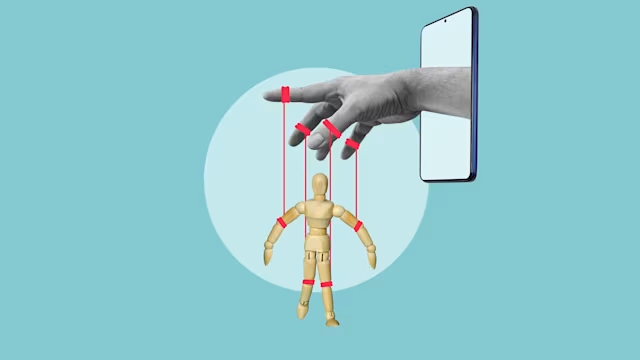
⚡ Pushback and Policies Grow Against Children’s Use of Technology
⚡ Districts Try New Strategies to Address Plunging Academic Performance
⚡ Families, Public and Private Schools Wrestle With ‘Choice’
⚡ Potential Fallout From Dismantling the Department of Education
The Trump administration’s plans to eventually slash the Department of Education were previewed by the conservative policy playbook “Project 2025.” Despite several outstanding lawsuits, the administration largely made good on that promise in the last year with a massive reduction in force hitting the department. Between November 2024 and November 2025, the number of employees fell by 42 percent, according to analysis from The New York Times.
The official rationale for the cuts is that they “empower states to take charge and advocate for and implement what is best” for students’ education, according to Secretary of Education Linda McMahon.
There is skepticism from experts across both sides of the aisle on the feasibility of actually dismantling the Department of Education. Chester E. Finn Jr., president emeritus and distinguished senior fellow at right-leaning Thomas B. Fordham Institute, believes Congress will not approve a full cut and that the move is more “symbolic” than anything. Aaron Loewenberg, senior policy analyst at left-leaning think tank New America, believes the swath of lawsuits could slow down actual implications seen this year.
“This could be tied up in courts for a long time. The courts typically aren't known for their speed,” he says. “It’s both not right to say it’s a huge deal, and also not right to say it’s nothing. We really just don’t know yet.”
I’m not hopeful that these changes will lead to good things for students and families. ... But maybe it’ll be less disruptive than some of us think.— Aaron Loewenberg“I’m not hopeful that these changes will lead to good things for students and families,” Loewenberg adds. “But maybe it’ll be less disruptive than some of us think.”
Even the threat of a shuttered department could bring consequences.
“It’s already having a negative effect on the field in terms of the confusion and delays right now,” says Elena Silva, president of the research nonprofit Learning Policy Institute. “It’s going to impact states, of course, it’s going to impact localities. It’s going to impact districts and students and families.”
Experts previously expressed concerns to EdSurge about special education services, which are housed under the Department of Education. Advocates fear that the reduced federal workforce erodes the ability to provide students with accommodations and undermines processes for reviewing complaints about potential accessibility violations. Last month, civil servants who had been laid off were called back to help with the backlog of discrimination cases.
“There’s both this question of which states will be affected most deeply by this, which states will have the most capacity to be able to manage it, but then there’s also the question of which students the federal government is set up to protect and to provide services for,” Silva says, pointing toward students with disabilities, in high poverty areas and those for whom English is a second language. “Those will be affected most because there won’t be the protections and the oversight necessary to ensure that they really do have a high-quality education.”
Finn says his “biggest worry” with the Department of Education is less about cutting the department itself and more on the fate of the data housed within the department. In March, nearly all staff were laid off at the National Center for Education Statistics, which collects a wide range of school-related data including on academic performance, population and literacy rates.
“NCES was the worst possible place to start gutting; it’s the oldest, and in my opinion most central, part of the Department of Education,” he says. “It’s the most objective, the least political, it’s just gathering information that is of universal interest to people: It’s not Republican or Democratic, it’s not red state [versus] blue state.”
The National Assessment of Educational Progress, better known as NAEP or the Nation’s Report Card, also saw cutbacks with several of its assessments.
“I can’t even think of a good analogy; it’s like going to the Department of Agriculture and cutting corn and pigs,” Finn says. “In terms of overall well-being to education, the data is absolutely essential.”
Loewenberg pointed toward some reports of attempts to walk back some of the data collection cuts, but still has concerns.
“I think it’s a small comfort, but I think people who aren’t working on education policy day in and day out don't understand how much the education field depends on that good data that is collected by them,” he says.
— Lauren Coffey
⚡ Continuing Raids Signal Another Difficult Year for Immigrant Students
Amid hardline promises from the Trump administration to increase deportations last year, educators across the country found themselves grappling with how to support the physical and emotional safety of their students.
Throughout 2025, experts spoke again and again about how immigration raids, which included parents being apprehended in school drop-off lines, scared families into keeping their children home from school.
What we’re recommending for school districts is to assume that what we're seeing now in Minneapolis and some of the threats from Chicago or North Carolina, assume those could come to your door and be prepared.— Alejandra Vázquez BaurThere’s no reason to believe that the upcoming year will be any easier, says Alejandra Vázquez Baur, director of the National Newcomer Network focused on equity in K-12 schools.
“I think we anticipate that it will get more complex throughout this year, between now and the end of this school year, and especially as we prepare for a new school year in [fall] 2026,” Vázquez Baur says. “In the last year, we've seen several schools respond to major immigration enforcement activities around their school by perhaps closing for the afternoon or closing for the day in response to family concerns and to protect their student communities, especially those that have high populations of immigrant students or children of immigrants.”
Vázquez Baur says when Minneapolis immigration raids — which included the shooting death of a woman at the hands of an ICE agent — led local schools to close last week, it’s the first time she can remember an entire district going remote over physical safety concerns. The district announced Friday that parents could opt into remote learning for their children for a month in support of those who may be afraid to go on campus.
“That says something really serious. It has been pretty common for school leaders, even myself, to say that the schoolhouse is often the safest place for students,” Vázquez Baur says. “This is the first time that administrators decided that’s not necessarily the case because we cannot control immigration enforcement activity right now. We are not sure how they’re going to respond, if they will respect our policies, and for two days they let students stay home. I don’t think that this is the last time that we’ll see decisions like that being made.”
Over the past year, the increase in immigration agents operating around schools has prompted districts to revise or create policies on how their employees interact with non-local law enforcement, she adds. Some districts have changed their procedures to ensure that staff bring anyone named in a warrant to the front office rather than allowing immigration agents to enter classrooms, for example.
“What we’re recommending for school districts is to assume that what we're seeing now in Minneapolis and some of the threats from Chicago or North Carolina, assume those could come to your door and be prepared,” Vázquez Baur says. “We really encourage school and district leaders to stay up to date on any actual policy changes at the federal level, or Supreme Court cases that might impact student rights, especially without a robust Office of Civil Rightsto track civil rights challenges or complaints in districts, and prevent pre-compliance — because pre-compliance in and of itself violates civil rights at the local level.”
— Nadia Tamez-Robledo
⚡ With AI Here to Stay, Misinformation Literacy to Remain a Key Skill
The dialogue around AI in education over the past year included a healthy dose of acceptance that generative artificial intelligence is here to stay, whether teachers incorporate it into their lesson plans or not.
Beyond devising ways to make sure students don’t stunt their own learning by over-relying on AI, whether that’s with permission or bald-faced cheating, questions remain on how to best help them master another facet of AI literacy: telling fact from fiction when the technology can be used to generate fake content or spin up incorrect information in an effort to people please.
We’re reaching a tipping point where children and adults are hitting kind of like their personal limits with these online experiences.— Kris PerryKris Perry, executive director of Children and Screens, says youngsters who have grown up in the digital age already have a healthy skepticism of information online. But just as learning to read is something that must be taught, and something that rewires the brain in the process, growing those online discernment skills has to be reinforced and strengthened.
“[Kids are] pretty good at understanding how digital content is designed — and what the overarching purpose of these platforms is really — to keep you online,” Perry says. “I think teens really do get that, one skill that we have heard over and over again that it’s important for teens to acquire, is really the ability to pause, to slow down and not react immediately to online content. It’s good to know that you have to be calm, pause and critically evaluate what you’re looking at and remember that it’s designed to get you to be emotional.”
Navigating online misinformation is likely to become trickier as generative AI continues to improve, as demonstrated by Google’s advances with its Nano Banana image generation model. One reviewer said the tech “erases what’s left of the line between reality and AI.”
When protecting young users from misinformation on social media, Perry says it’s clear that state and federal policymakers are the ones feeling the most urgency to put up firewalls — not so much the tech companies — with legislation like the Kids Online Safety Act and enforcement of the Children's Online Privacy Protection Act.
“We’re reaching a tipping point where children and adults are hitting kind of like their personal limits with these online experiences,” Perry says. “That’s because it’s been over a decade of what are essentially online experiences that are becoming increasingly low-quality. The silver lining is it’s becoming universally understood that these products are unsafe and that something needs to be done, but it hasn’t yet reached a point where we can say, ‘Oh, good, the protections are in place.’”
— Nadia Tamez-Robledo
⚡ Pushback and Policies Grow Against Children’s Use of Technology
Nearly 20 years after the iPhone was released, half a decade after the pandemic pushed most learning online temporarily, and three years after the launch of ChatGPT, 2026 may see a major movement gain traction against children’s use of technology.
The signs are all there, in polling data, national headlines and congressional bills.
A lot of what I hope for over the next year is that nuance is brought into conversations — that there aren’t knee-jerk reactions.— Amelia VanceThis academic year, many schools are requiring students to keep their cellphones out of sight, and a group of school districts is suing social media companies for allegedly contributing to a youth mental health crisis. Meanwhile, major news publications are chronicling tragic teen suicides that correlate with heavy use of AI chat tools — including for school assignments. More than a dozen bills have been introduced to Congress aiming to protect children from negative consequences of digital tools and services, and multiple government bodies recently probed the possible ills of screen time in schools.
In education, it could all add up to an extreme “singular solution,” like a ban on edtech or new policies that permit parents to opt their children out of using tech tools entirely, says Amelia Vance, president of the Public Interest Privacy Center.
Such a move might not take into account the protections already in place, like for example the Children’s Internet Protection Act, which mandates that schools receiving federal funding filter out online content potentially harmful to minors.
“A lot of what I hope for over the next year is that nuance is brought into conversations — that there aren’t knee-jerk reactions,” Vance says.
More broadly, even as the Trump administration promotes unfettered growth for Silicon Valley AI companies and endorses use of AI in schools, concerns about children’s use of technology could contribute to broader public action and activism against the proliferation of AI — maybe even fueling a political movement.
“This is much more politically popular than someone who is casually looking at what the White House is saying might think,” Vance says. “It really is something that hasn’t broken through in mainstream conversations, but really is essential for schools to pay attention to, especially since so many of them launched bigger AI initiatives this year. They might face pushback from state legislators or their community that they aren’t expecting.”
— Rebecca Koenig
⚡ Districts Try New Strategies to Address Plunging Academic Performance
Schools have seen sputtering academic recovery postpandemic. Recent national assessments have revealed declining reading and math scores for students. They’ve also spotlighted growing gaps between higher-performing students and lower-performing students, alarming experts.
At the same time, public schools are facing existential challenges, including teacher shortages and burnout, falling enrollments and pinched budgets, exacerbated by the end of federal pandemic relief funding.
In response to these trends, states have become open to changing how they measure assessment and accountability for schools.
Without a silver bullet to fix student learning outcomes, schools are resorting to scattershot.But schools will see a range of other changes in response to this as well.
Though there’s been a lot of focus lately on the science of reading in elementary schools, there also seems to be growing interest in improving middle school reading instruction, to address the “adolescent literacy crisis,” arising in part because the pandemic meant some students missed fundamental reading lessons during their early elementary school years, notes Megan Kuhfeld, director of growth modeling and analytics at NWEA. The problem is that many ways schools give a boost to students who have fallen behind — such as summer school or tutoring — depend on funding, Kuhfeld says. As schools scramble to continue basic operations, this might get tougher, she says.
Without a silver bullet to fix student learning outcomes, schools are resorting to scattershot. Districts are experimenting with cellphone bans, which they hope will boost achievement by eliminating distractions in the classroom. Districts are also turning to AI for a range of services, from mental health support for students to personal tutors, hoping that personalizing education and care with the aid of technology will shoulder some of the burden.
Perhaps a greater reliance on student data will help identify solutions to the many challenges schools are confronting. Schools are more interested in mining data and tools that track student progress for insights these days, says Jim Bowler, general manager of classroom solutions for the assessment company Riverside Insights. These allow for schools to personalize instruction, the “Holy Grail of education,” he adds.
Some believe that solutions to problems like chronic absenteeism, considered a cause for declining performance, are hiding in that data. After all, attendance can serve as an early warning system for struggling students, one that can alert schools before a student starts failing out.
With the middle school literacy crisis, for instance, data tends to show that student attendance falls off after fifth grade, an issue that can be compounded by literacy struggles, says Kara Stern, director of education for SchoolStatus, which sells family engagement and attendance software. When a student enters middle school, they are entering into a confusing new context, leaving the elementary school they knew for a new building, new adults and new academic challenges. Understandably, the kids can feel lost, or disconnected, which is precisely when they are likely to skip school. If schools recognize that the pattern isn’t random, they can take proactive steps that wouldn't cost anything to help get kids back, Stern says.
Certainly, how schools treat absenteeism will likely keep changing, as they continue to grapple with how to coax students back into classrooms. The last couple of years have seen many schools turning away from a punitive, truancy approach. Instead, for some of the students most at risk of missing class, schools are trying to remove barriers to attendance — by providing gas vouchers or free transportation passes that students can pick up at the office; or providing resources for hygiene, like the ability to do laundry at school, which can prevent some students at risk of homelessness from showing up to class, according to Stern.
— Daniel Mollenkamp
⚡ Families, Public and Private Schools Wrestle With ‘Choice’
Last year saw major milestones for the school “choice” movement. Most notably, Congress passed the country’s first-ever federal choice program. Slated to start in 2027, it’s been described as a “voucher-style” system that functions as a jab in the arm to the effort to divert public funds in order to support students enrolling in alternative education options, such as private schools.
States will have to opt in, and a number of states have historically resisted vouchers, which remain controversial. But some states have thrown their arms around these options. For instance, Texas, one of the largest states, passed a $1 billion voucher system this past year, for which it has begun to approve private schools.
The consequence is that, moving forward, some anticipate that education will look more like a consumer sector.
Schools — both private and public — have ramped up efforts to market directly to families, feeling the need to capture their hearts and minds (and the tax dollars that follow their children).Schools, families, regulators and researchers are grappling with this. Some take that metaphor literally. For instance, Center on Reinventing Public Education researcher Ashley Jochim told EdSurge that school choice movements need a “lemon law,” a chance to claw back funds should schools not deliver on learning outcomes. And a number of companies are positioning themselves to benefit, from Odyssey — whose selection to run Texas’ voucher program sparked some criticism — to early childhood navigator tool Winnie, whose CEO told EdSurge she aims to build a comprehensive school navigator tool to help families wade through the options in front of them.
As EdSurge prepares to dig into this topic in 2026, experts have shared that:
They expect the federal tax-credit scholarship will speed up enrollment declines in public school districts as well as drive up the need for new revenue sources. Yet, experts also say tax-credits may also provide new revenue streams that can fund services for these districts, such as providing transportation for homeless students.
Some believe that the systems — even in their most “evolved” regulatory landscapes — lack sufficient academic accountability and oversight. But proponents praise the options for allowing families to have greater control over their children’s education, especially in areas where families feel most exasperated with public schools.
Schools — both private and public — have ramped up efforts to market directly to families, feeling the need to capture their hearts and minds (and the tax dollars that follow their children).
Despite the promises of the movement, it’s tough for families to make choices, in part because the information available to them about these new options may be confusing or scant. Families may also be unaware of the different legal requirements these private school options operate under, and are often making decisions to enroll in private school options based on word of mouth and out of frustration with public schools.
Interestingly, some suggest that students are more often enrolling part-time, or in microschools, as families with homeschooled students and in rural areas look to benefit from voucher systems.
— Daniel Mollenkamp
Rebecca Koenig, Lauren Coffey, Nadia Tamez-Robledo and Daniel Mollenkamp are EdSurge journalists.
Popular on EdSurge
Read Next
News
Childcare
Hundreds of Thousands of Eligible Kids Are Waiting for Childcare Assistance
Voices of Change
Teaching and Learning
Voices of Change
Artificial Intelligence

News
Attendance