Families at All Income Levels Struggle to Find Child Care
Wealthy and middle-class households are not immune to the problems of affordability and access.
January 21, 2026
Andrii Zastrozhnov/Shutterstock
It started as an “if you know, you know” situation for stressed parents dealing with the high costs of — and often slim options for — child care. Then, during the pandemic, the difficulty mounted.
Now, it has reached a new peak, according to a new report.
The RAPID Survey Project at the Stanford Center on Early Childhood found U.S. parents across all income levels have trouble finding, and affording, child care for their children.
“The data are pretty stark and visually stunning to see how things are progressing over time,” says Philip Fisher, director of the Stanford Center on Early Childhood and founder of the RAPID Project. “It can’t be dismissed by saying, ‘It’s not true.’ It’s not an anomaly of a one-time survey; you can see from our data what’s been happening with households.”
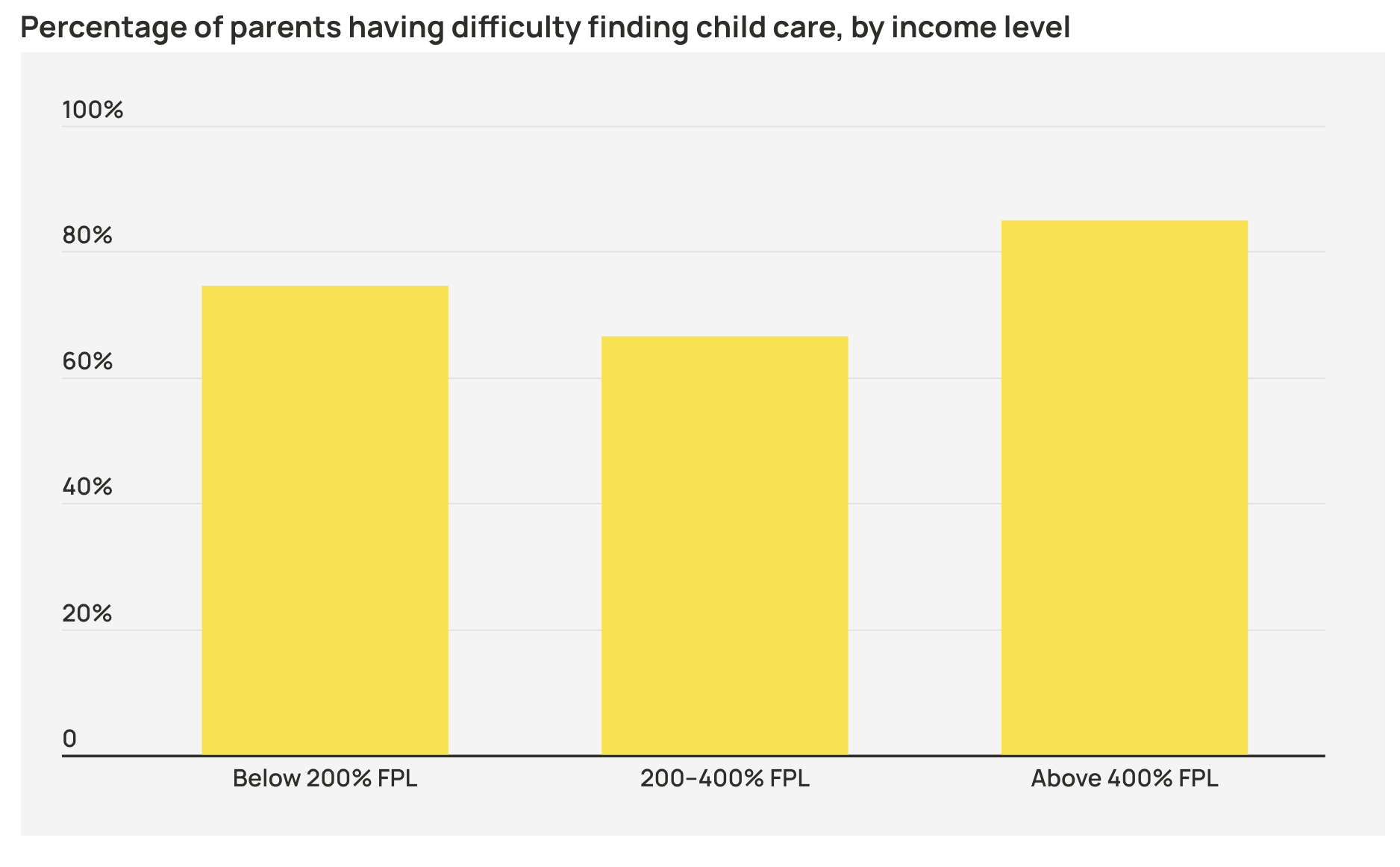
Nearly three out of four parents with children under age 6 looking for child care in June 2025 had trouble finding it, with 85 percent of high-income families citing difficulty, followed by 75 percent of lower-income families and 67 percent of middle-income families stating the same.
They grappled with twin problems of affordability and access. Some families couldn’t find care they could comfortably pay for, while others couldn’t find coverage that was reliable and safe.
RAPID classified the income class of respondents based on the federal poverty line, which is a household income of $32,150 for a family of four in 2026. Families that earn less than two times of the federal poverty line were classified as low-income, with families earning 200 to 400 percent of that amount classified as middle-income and those at 400 percent or more classified as upper-income.
The latest findings are a shift, Fisher says, from what was previously perceived as a problem solely for lower-income families or “working poor” families, or those whose jobs made them unable to qualify for social programs because they made slightly too much money.
“The questions we’re hearing batted about in the media of, ‘Is affordability a thing or not,’ — our data is showing quite clearly it’s an issue that’s just not an issue for a group different than your own, but for everyone,” he says. “And if it’s not hitting them, you know someone it is having an impact on.”
NEWSLETTERS
STAY AHEAD IN EDUCATION.
Sign up for EdSurge newsletters for timely news, insights and analysis.
RAPID began collecting data five years ago, but Fisher says this is the widest-spread effect he’s seen across class levels since the surveys began in April 2020.
“What we’re finding in our data now is these are issues affecting a much broader continuum with families with young kids in this country,” he says. “It’s people who have well-paying jobs with benefits. But because of the cost of utilities going up so much, products — including diapers and formula — the cost of food and housing all increasing, people are feeling the pinch across the economic continuum.”
Affordability
A study published last month by the Brookings Institution found that one-third of the nation’s middle class struggles to afford basic necessities, which includes child care. Rising costs could shine a light on the child care sector as a whole, as more discussion begins to swirl around it at a national level — and in political stump speeches.
Affordable child care was championed by new New York City Mayor Zohran Mamdani, as well as the newly elected governors in Virginia and New Jersey. That suggests, according to Melissa Boteach, chief policy officer at the nonprofit Zero to Three, that “this is a political issue that you can win on.”
“I think that we're going to start to see these issues further rise to the top of the political agenda because it's becoming untenable for families,” Boteach told EdSurge in December. “It's not like this is just a blue state issue. This is a thing where people across the ideological spectrum need to find affordable care for their children and they want it to be quality care.”
In some places, political rhetoric is turning into actual policy. Several cities and states launched splashy early childhood programs in the last year, including New Mexico’s universal child care program and Vermont’s public child care funding model, aimed at making child care more affordable, and therefore more accessible, to its residents.
Access
The dichotomy between high costs of child care and low pay for child care providers and workers is more stark than ever, as more than half of child care providers recently reported that they struggle with going hungry. The long hours and low pay associated with the work caused a mass exodus from the field postpandemic, creating staffing shortages that caused thousands of centers to close and ultimately made it even harder for families to find reliable care for their children.
According to the latest RAPID study, 1 in 5 families experienced difficulty finding child care — and of that percentage, nearly 60 percent of them say it was due to a lack of caregivers. Additionally, one-third of parents had other concerns about disrupted child care, including due to utility outages, illnesses, extreme weather and regarding safety. A parent in North Carolina, for example, mentioned their provider was both sick and out of town within the same month. Another respondent in Indiana mentions their child care center had an extended power outage, affecting care.
Lauren Coffey (@Lauren__Coffey) is a reporter at EdSurge covering early childhood education and technology at the K-12 level.
Popular on EdSurge
Read Next

Voices of Change
Artificial Intelligence

News
Visual Arts


News
EdSurge Podcast