I’m a Teacher, and Defending Public Education Is Now Part of My Job
When funding, policy and student futures are at stake, teachers must step beyond the classroom to shape change.
January 28, 2026
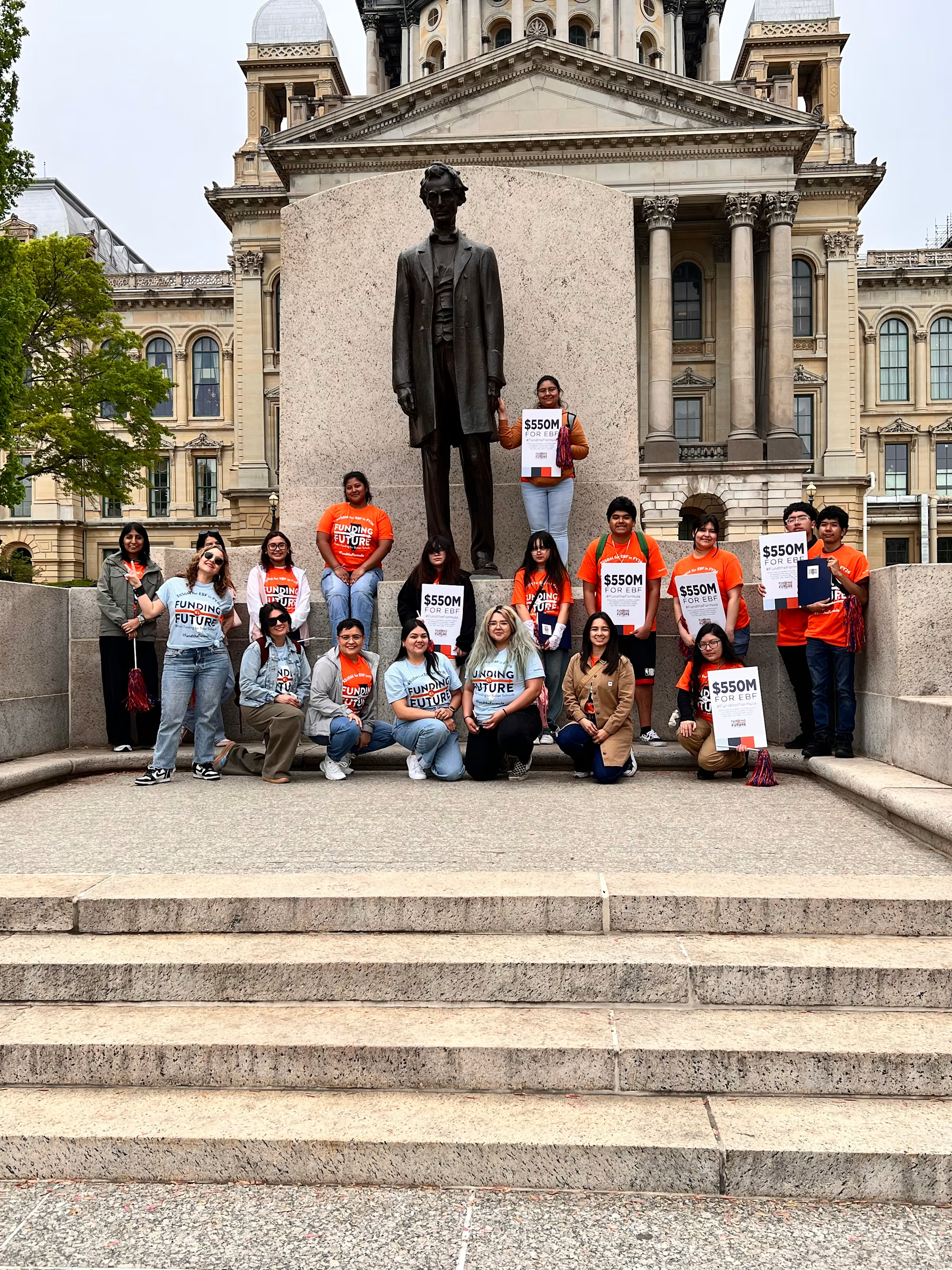
Photo courtesy of Sofia Gonzalez
I didn’t choose activism. It chose me the moment I realized my students were walking into my classroom carrying entire systems on their backs — systems too heavy for 15-, 16-, 17-year-old shoulders.
But suddenly, in the last year, everything crystallized.
It started as a field trip, at least on paper. Permission slips, buses, community-organization sponsors and chaperones. But I knew it was more, which is why the organizers asked me in advance if I could speak last spring at Advocacy Day 2025 with Funding Illinois’ Future. When I said yes, I didn’t just prepare a speech about increasing evidence-based funding for public education across Illinois; I prepared my students.
We were on the steps of our state’s Capitol in Springfield, Illinois. In front of me stood elected officials, Chicago Public Schools leaders and students — my Morton East High School family. Behind me: Abraham Lincoln’s statue, the Capitol building towering like history itself was paying attention to me, to us. They had our back, even if it was for just a moment. Somewhere between those two worlds, my mouth, heart and soul caught fire.
I delivered one of the most significant speeches of my life — almost levitating as the stage itself pushed me upward. My students were cheering, holding up protest signs, fists raised, cameras rolling. It felt like the heavens cracked open.
Then, while I was still coming down from that moment, my students stepped into theirs.
The same students who were trained by community organizations during class how to speak with their state representatives marched into the Capitol and advocated for their schools, their communities, and their futures — not as an afterthought. Not as an extra credit activity. But as part of an actual assignment that spring semester.
And as the kids often say, they understood the assignment.
That day reaffirmed to me something permanent: teaching and revolution aren’t separate lanes. They run parallel. They feed each other, and sometimes they collide, shifting the entire trajectory for the students and teachers on that path. Let me explain.
NEWSLETTERS
STAY AHEAD IN EDUCATION.
Sign up for EdSurge newsletters for timely news, insights and analysis.
The Urgency of this Moment
Here’s what makes the state of education more urgent than ever:
We are living through a moment where the U.S. Department of Education is being gutted piece by piece. Critical programs, including Title I and Title III, which provide funding that directly supports our multilingual learners and low-income communities and offers free and reduced-price lunch programs, are being redirected to agencies such as the Department of Labor, reducing transparency and accountability for schools. The infrastructure intended to protect public education is being hollowed out in real time, reshaped by political agendas rather than student needs.
When I talk about teacher activism, I’m not talking about a trend. I’m not talking about a survival strategy or more hashtags. I’m talking about stepping in because behind the headlines, the safety nets for our kids and educators are quietly unraveling.
This is an “all-hands-on-deck” era, whether we asked for it or not.
Still, this is how teachers can rise. Admitting my bias, I truly believe that teachers are the ones who will lead the way, cutting a path forward for our nation’s kids. You can’t convince me otherwise.
Luckily, I have some ideas from my journey into education activism that can contribute to the collective in real time.
From Gathering to Good Trouble
Before a movement ever earns its name, it begins quietly with people choosing to gather. These people are usually tired, and often bruised by institutions that promised care and delivered scarcity. Still, they come and they show up. This is why fellowships (like this one), affinity groups and teacher-led networks matter now more than ever. As federal support erodes and safeguards wane, these spaces become our alternate landings — our emergency generators when the power goes out.
At a time when public education is under siege, teacher voice is not a luxury. It is the leverage.Inside these rooms, teachers do more than meet. We remember who we are, we strategize and we tend to one another. We sharpen our thinking and soften our gaze. We disrupt the isolation schools often produce and reclaim our place as the frontline witnesses, caretakers and truth-holders. When educators gather with intention, activism no longer feels lonely or impossible. It becomes a collective, shared inhale and a long exhale.
As an EdSurge Voices of Change fellow and an alum leader across multiple fellowships and affinity spaces, I’ve watched community change the trajectory of teachers’ lives, including my own. These networks open doors, pass microphones and invite us into rooms we were never meant to enter quietly. Many even invest in us to travel, speak and teach our truth because lived experience is not anecdotal; it is expertise. The return is soul-nourishing, healing, liberating and life-giving. This is how movements endure: not through lone saviors, but through small rooms of educators committed to getting into “good trouble,” as former U.S. House Representative John Lewis once urged.
Eventually, the work refuses to stay contained within four classroom walls. Teachers must step into conferences, panels, workshops, webinars, podcasts and policy spaces — not to perform, but to push. Not to ask for permission, but to influence decisions made far from students’ lives. Teachers don’t need a seat at the table. We are the damn table!
Yet, speaking is only half the work. The other half is building liberated spaces within our schools, with classrooms where marginalized students breathe freely, multilingual learners are affirmed and the curriculum becomes a mirror rather than a wound of exclusion. These spaces are living prototypes of the world we want our students to inherit.
Teachers are America’s most consistent, real-time researchers. Our lived experience is data. Our classrooms are case studies. When we carry that truth into policymaking, we bridge the gap between theory and reality. At a time when public education is under siege, teacher voice is not a luxury. It is the leverage.
Activism Without Access
Most teachers don’t have foundations backing our advocacy. We don’t have PR teams or political consultants. But what we do have is creative innovation. We have the kind of resourcefulness that turns a $200 classroom budget into an entire universe.
Teachers can mobilize through group chats, free Zoom links, grassroots partnerships and digital tools that level the playing field. We can apply for teacher-only grants and fellowships that open new doors our school buildings can’t swing open. We can leverage the term “teacher” — which still carries moral weight — to gain access to spaces that might otherwise overlook us.
We have always made magic with less, and activism is no different.
We don’t wait for perfect conditions. We can’t afford to, so we need to create them. It’s been us, it’s always been within us all along. As bell hooks reminds us, liberation is not something we wait for — it is something we practice.
This story is part of an EdSurge series chronicling educator experiences. These stories are made publicly available with support from the Chan Zuckerberg Initiative. EdSurge maintains editorial control over all content. (Read our ethics statement here.) This work is licensed under a CC BY-NC-ND 4.0.
Sofia Gonzalez is a high school English teacher at Morton East High School in Cicero, Illinois.
Popular on Edsurge
News
Hundreds of Thousands of Eligible Kids Are Waiting for Childcare Assistance
Moriah Balingit and Lauren CoffeyNews
A Principal and a Student Reviewed the New ChatGPT for Teens. They Had Plenty to Say
David WeldonRead Next

Opinion
Professional Development
Shoot, I Did It Again: 3 More Ways to Implement Video in Professional Learning