More Than Half of Child Care Providers Have Gone Hungry, New Report Finds
The acute SNAP crisis may be over for now, but high grocery prices and low wages mean the risk of hunger persists.
December 9, 2025

David Pereiras/Shutterstock
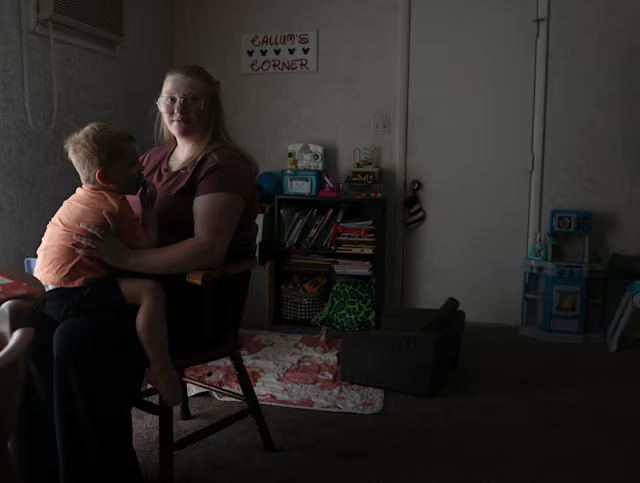
An early childhood center director in Washington re-draws the weekly menu to contend with the rising cost of food. A home-based provider in Arkansas stays up late crunching the budget numbers, stretched thin between food and health insurance. A provider who watches children of her friends, family members and neighbors has a sleepless night worrying about if the growing children have enough to eat.
Discussions have long swirled around children’s food insecurity, most recently peaking with the paused Supplemental Nutrition Assistance Program (SNAP), formerly known as the food stamps program. That program is reinstated, though its requirements are changing by the end of next year.
Now, a new study has found that children’s caretakers, too, are struggling with hunger more than ever.
According to a survey from the RAPID Survey Project at the Stanford Center on Early Childhood, more than half (58 percent) of child care providers surveyed experienced hunger in June 2025 — which is one of the highest percentages the organization has seen since it began collecting data in 2021. Some respondents – including the providers from Washington and Arkansas mentioned previously – shared personal experiences with hunger, such as those mentioned above.
“I think most people think we’re in a very prosperous country and with hunger, there’s something of a mindset around it of abject poverty,” says Philip Fisher, director of the Stanford Center for Early Childhood and founder of the RAPID Project. “But we’re starting to talk about these issues as a canary in the coal mine; there’s signals it’s starting to spread to a much wider swath of population.”
The latest findings are a bump from June 2021 to May 2025, when an average of 44 percent of the surveyed child care providers reported experiencing hunger. The spike, while alarming to Fisher, was not surprising. The cost of groceries is rising, and there have also been cuts to programs that provide food for food banks.
“It’s likely people are seeking free food where it’s available, but that is becoming harder and harder to access,” Fisher says, adding his son, who runs a food bank in rural Washington state, has seen an increased demand.
“Food insecurity” is defined by the U.S. Department of Agriculture as a household’s access to adequate food. The RAPID Project considered a respondent “hungry” if they experienced at least two of the five food insecurity scenarios:
If the food you bought went bad, could you not afford to replace it?
Can you not afford to eat balanced meals?
Did you or other adults in your household ever cut the size of your meal or skip meals because there wasn’t enough money for food? If yes, how often did this happen?
Did you ever eat less than you felt you should because there wasn’t enough money for food?
Were you ever hungry but didn’t eat because there wasn’t enough money for food?
Poonam Gupta, a research associate at the Urban Institute in the Tax and Income Supports division, says while “hunger” is an immediate condition, the usage of the “food insecurity” label showcases a longer-term issue.
NEWSLETTERS
STAY AHEAD IN EDUCATION.
Sign up for EdSurge newsletters for timely news, insights and analysis.
“Even if you’re not currently hungry in the moment while taking the survey, you can still be food insecure,” she says.
The reported food insecurity spanned across all types of child care providers. Fisher said center-based directors had the lowest rates of food insecurity among the group, followed by home-based providers, with center-based teachers and providers of family, friends and neighbor care seeing the highest rates.
“There’s been a ton of reporting on how broken the child care system is and a lot has to do with low wages,” he says. “So it’s not surprising it's across the board.”
Gupta added early childhood education teachers, and other low-income workers with hourly wages, are in a particularly tough spot because of the instability that comes with weekly schedules.
“A lot of attention is paid in general to the low-income workforce, but folks that have non-traditional or inconsistent hours tend to be at the highest risk,” she says. “There’s a type of instability in not being able to predict when your hours are. And if you’re an early childhood education provider and have children of your own, it’s difficult for you to afford child care and even more difficult to meet the work requirements to get SNAP benefits.” The program requires recipients to work at least 80 hours per month.
Early childhood care providers’ schedules can be particularly volatile, where workers can get sent home if, for example, not enough children are in attendance on a given day.
Hunger is widespread for children and adults, with 1 in 4 households experiencing food insecurity in 2024, according to the Urban Institute. But Fisher and Gupta believe the general public isn’t well aware of hunger among adults. They pointed out that most efforts — both from organizations and in research projects — largely focus on children’s food insecurity.
“I think the images they show perpetuate these ideas that the people who are hungry are in an extreme margin,” Fisher says, rather than the reality that much of the general public is at risk for going without adequate food.
The issue points to an irony at the heart of how child care works in the U.S. Child care costs families more than ever, with Child Care Aware of America finding that parents in most states pay more for child care each month than for rent or mortgages. However, according to the Bureau of Labor Statistics, the average pay for a child care worker is below $12.25 per hour. Child care workers with a college degree get roughly $14.70 per hour.
Gupta estimates that food insecurity, including among early childhood care providers, will get worse. Upcoming changes to SNAP are slated for October 2026 and include an increased age limit and removing exemptions for veterans, those experiencing homelessness and those aging out of the foster care system. According to 2024 data from the Center for the Study of Child Care Employment at the University of California at Berkeley, roughly 43 percent of child care workers receive some form of public assistance, including SNAP and Medicaid.
“If anything, we only expect this to get worse in the coming year because of all the disruptions being made, mainly to the SNAP program,” she says.
Lauren Coffey (@Lauren__Coffey) is a reporter at EdSurge covering early childhood education, the child care workforce and technology.
Popular on EdSurge
Read Next


Voices of Change
Artificial Intelligence

News
Childcare
Hundreds of Thousands of Eligible Kids Are Waiting for Childcare Assistance


Voices of Change
Coding
How Coding Can Cultivate Deep Civic Engagement

News
EdSurge Podcast
Two Students, Two Questions They Wouldn’t Let Go

Opinion
Artificial Intelligence