I Was a First-Generation Elite Private School Graduate. My Kids Won’t Follow My Path.
A reflection on what crossing into elite schooling offered me, what it took, and the intergenerational residue of poverty.
By Mi Aniefuna
February 2, 2026
FotosForTheFuture/Shutterstock
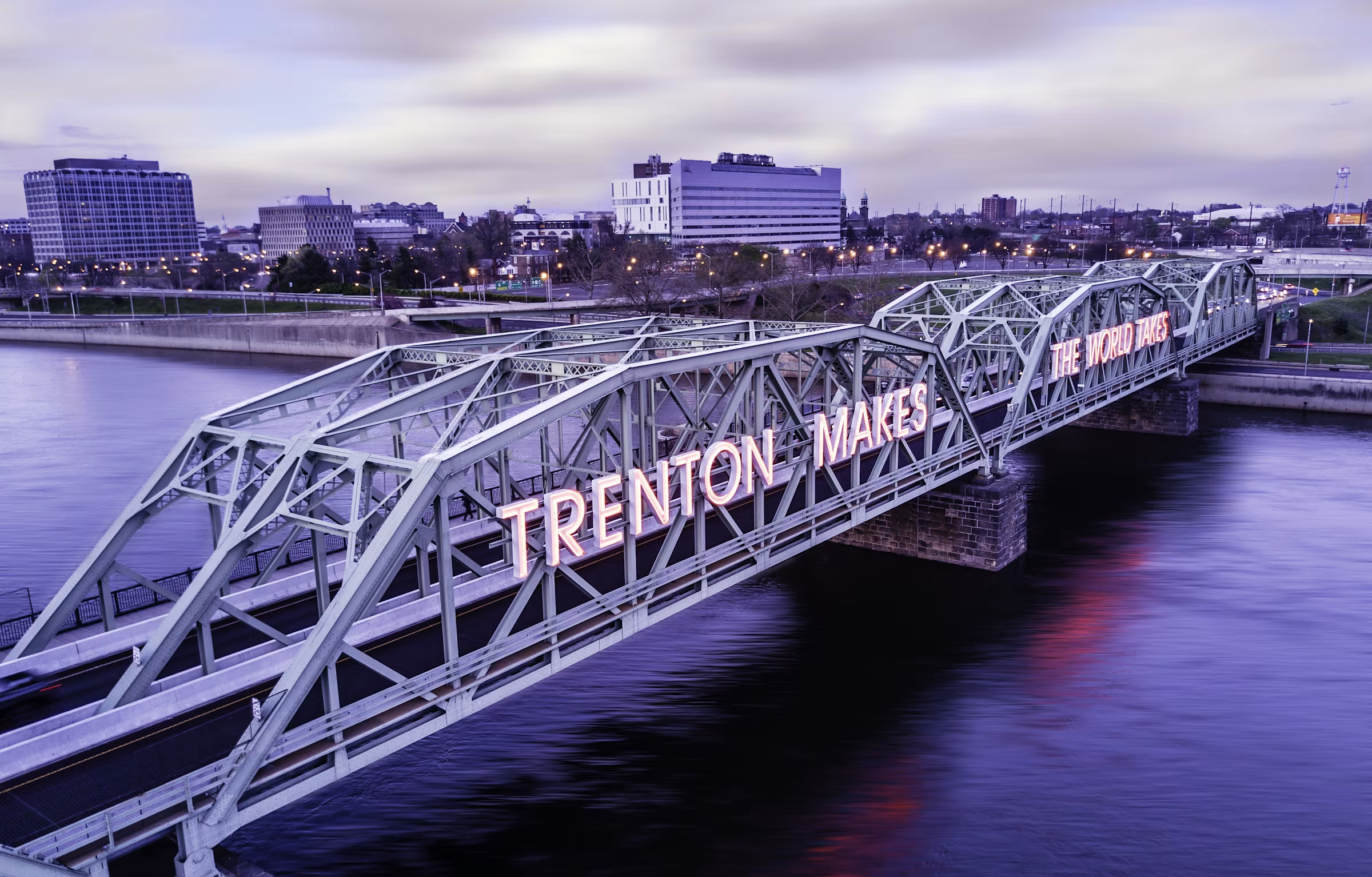
As we drove across the bridge that read, “Trenton Makes, the World Takes,” the red lights brightened my worried face. It took 20 minutes to drive back home from my admissions interview, but the Delaware River felt like the width of the Atlantic Ocean between the grassy farmlands in Bucks County, Pennsylvania, and my small concrete jungle in Trenton, New Jersey. My mom drove us quietly with a gentle smirk, knowing I’d aced that interview, until I finally broke my silence.
“I’m not going, Mom.”
She looked at me through the rearview mirror, her eyebrows lifted, open to hearing my opinion. I said, “I can’t go — it’s just too many white people.”
Third grade Mi had realized that this was the first time I’d been in a predominantly white space. I did a lot of observing and noticing. I didn’t yet have the words to articulate that this was the first time of my life that I’d felt viewed, not seen. I felt hyper-aware of the contrast of my Blackness — my African American vernacular English, my beef-and-broccoli colored Timberland boots, my Ecko Red hoodie and Girbaud jeans, and my gold name plate chain. I embodied a stereotype of “ghetto” that seemed antithetical to what I saw at the private school: the double-popped polo collars under blink-182 crewnecks, above-the-knee khaki shorts, and six-figure cars in the carpool line. This was the first time in my life that I felt othered. And it was overwhelming.
But I made a proposition. I agreed to attend the school — unbeknownst to me, I had no choice — and in return, I declared that I would not “act white,” to fit in like the other few Black students that I observed in the school. I refused to negotiate what I perceived as expressions of my Blackness.
I attended this predominantly white institution (PWI) from fourth through eighth grade. I wrote in my piece in the sixth-grade literary magazine, “Crossing the ocean from an all-Black public school to a white private school…it has its privileges, but sometimes, it’s a burden.” While I was thankful for the opportunities presented, I silently carried the burden of the daily racist altercations at school. Most of the time, the psychological effects overshadowed the privilege.
Now, I’m a parent facing the same dilemma that my mom had more than two decades ago. With the best intentions for my children, knowing the assault to my self-concept in my formative years, do I put them in elite, predominately white spaces, or do I prioritize psychological safety?
The question might seem like a no-brainer, or maybe to you, it feels loaded, too. Can my wife and I offset their experiences at PWIs with culturally affirming enrichment at home and extracurricular activities, or are we repeating the cycle?
Before I became a dad, knowing my nonlinear path that’s been shaped by the residue of poverty, I’d ask myself: “Was it worth it?” Did I maximize the return on investment? Now, as a parent, the answer is much more nuanced.
NEWSLETTERS
STAY AHEAD IN EDUCATION.
Sign up for EdSurge newsletters for timely news, insights and analysis.
Reading, Writing, ’Rithmetic, and [Civil] Rights
Whether to enroll or not in a PWI in secondary schooling is not just a race and class question, it’s a question of resources and approach. I’m still not wealthy, but I have more than what I started with. And being an education and social policy researcher, I know what data shows about who gets what and where. My own experiences and my knowledge of how policies and funding affect quality of experiences in American schooling adds a layer of complexity to my contemplation about my children’s schooling.
When I graduated from my PWI, I was adamant to reenter culturally affirming spaces. I’d rejected some of the highest- ranked high schools in the country because I was done suffering. In middle school, I had filled dozens of composition notebooks with rage and sadness that could only be expressed through poetry and raps, although symptoms of my deep inner conflict sometimes landed me in the Head of School’s office. I was ready to rise and become who I was meant to be, not the muted, abbreviated version of me.
Arisen from the suffocating smog of anti-Blackness and intersectional othering, I could really appreciate the incredible foundation my private school had provided. That’s when my survivor’s remorse was born.
I noticed the differences in the curriculum. My parochial high school was a breeze — it was a repeat of things I’d been exposed to in middle school, and seeing what was new to some of my friends enraged me. It’s what Zaretta Hammond calls “cognitive redlining” alongside the hyper-punitive approach to discipline, which seemed to be the greatest priority.
I came of age in a Quaker school where we called teachers by their first names (something I never got used to) and third graders could leave the classroom for a bathroom break at any time. So when I saw my Catholic high school principal every morning for the uniform compliance check line, I stood in line, arms crossed, muttering every expletive I could think of. To make matters worse, the school disciplinarian was my AP History teacher, and he suspended me for having a visible cell phone. At that point, I was already in full rebellion.
I was shocked — a culture shock in my own culture. But it wasn’t being immersed in my culture that was shocking. It was seeing another form of racism and discrimination take shape in a predominantly Black school. The caveat: this school, in a working- class Black city, was led by white administrators and teachers. From kindergarten to 12th grade, we had one Black teacher.
I realized how good I had had it all those years at the PWI middle school. This cemented me into an activist. I got into so much good trouble in high school because of it. I had not only gained advanced skills in reading, writing, and ’rithmetic in my “better” PWI, as my late great-grandma Ella often joked, I had also inadvertently learned the ABCs of inequity.
Was It Worth It?
How do we measure success?
Researchers have tried measuring the concept of success for a long time. Is it highest level of education? Type of degree? Does a medical doctor or engineering degree beat a gallery wall of social science and humanities degrees? Are power, notoriety, income, or wealth markers of success? It’s hard to measure success, because our definitions vary by personal beliefs and values.
The first time I heard my name and the word “successful” in the same sentence, in the present tense, my head tilted slightly, forehead wrinkled, and I listened as the panel moderator read my bio, introducing me as someone who they perceived as “successful.” I thought, “Hmm — I guess it does sound pretty good.” But I feel like I’m still grinding and hustling to reach my elusive goals.
If we measure success, achievement, or attainment by income or field of study, the goal post just keeps moving. A six-figure salary can’t buy what it did 10 years ago. In most states in the U.S., the definitions of poverty and low income have changed dramatically. And we tend to favor STEM degrees over others, for reasonable explanations, despite the rates of STEM graduates who work outside their field of study.
When I finished college, struggling to find meaning and a job with benefits and a salary — typical millennial quarter-life crisis — the compare and despair Googling of my middle school peers fueled my angst. People I’d grown up in school with, who were children of surgeons, Hollywood executives, and partners at big law firms, were taking unpaid internships, studying abroad, or on their way to law school or medical school.
The question resurfaced: Was it worth it?
I resented what appeared to be a linear, fluffy path. We went to the same school but didn’t get the same education.
Unlike my postsecondary hustle, I assumed theirs didn’t include clocking out 5 minutes early at the sales associate job to catch the bus to the server job, then ending the night around 2 a.m. with the security job just to afford shelter, food, and basic clothing while taking 18 credits in college. At one point, I was forced to quit one of my jobs because of pneumonia I couldn’t shake.
I intimately understand the consequences of being a first-generation college student. Without the social capital, mentorship, guidance, and financial security, I struggled for a long time to find stability. And still, stability is fleeting and relative. This significantly influenced my career path and makes my resume not make perfect sense to someone who doesn’t know this type of grind.
But I’m a parent now, facing the same decisions my mom had to make. The difference? My kids are second generation, and their mom and I, having tried it all, can offer pointed advice along with access to spaces, people, and insight that first-generation graduates learn from trial and error, or never learn at all.
My path to where I am now, still grinding and hustling, wasn’t linear, and it’s still a bit winding. Knowing what I know now, with my self-concept and confidence restored, with the wisdom of a 30-something-year-old still figuring out some things through trial and error, and the residue of poverty still showing up sometimes, I make micro-calculations every day for my children’s safety. I know I can’t shield them from every potential racist, sexist, or discriminatory interaction, but I’m always considering their Blackness, gender, perceived class, and who they are when selecting the spaces we occupy. That knowing — the wisdom that shows up in how I parent — was worth it.
Mi Aniefuna is the senior manager of EdSurge Research.
Popular on EdSurge
News
Hundreds of Thousands of Eligible Kids Are Waiting for Childcare Assistance
Moriah Balingit and Lauren CoffeyNews
A Principal and a Student Reviewed the New ChatGPT for Teens. They Had Plenty to Say
David WeldonRead Next

News
EdSurge Podcast
Supporting Early Childhood Educators


Opinion
Artificial Intelligence
Will Kids Pay the Price for AI Panic?

Voices of Change
Artificial Intelligence
Why AI Made Me a Better Principal
News
EdSurge Podcast
Why Do So Many Teachers Crash in October?

News
Higher Education