AI Is Changing Classrooms. Teacher Expertise Still Sets the Direction.
January 12, 2026

Image Credit: Monkey Business Images / Shutterstock
One of my earliest memories of using technology for teaching and learning was when I taught English at a small high school outside Waterbury, Connecticut.
I had learned a couple of years earlier, when I taught in the U.S. Navy, to use mentor texts to model writing strategies, such as how to write a good summary. I wanted to take examples of my students’ writing from the prior year and share them with current students, to be relatable and available to them 24/7, when I was not. So I learned HTML.
Before turning to an AI-powered tool, teachers need a clear sense of the instructional purpose and the expertise required to evaluate its output. AI can generate lessons, questions and scaffolds within seconds — but only educators can determine whether that content is accurate, instructionally sound and appropriate for their students.Though I knew almost nothing about technology, I had a clear idea of what I wanted it to do for my classroom: help students work independently when I wasn’t available. With a clear pedagogical goal and just enough technical knowledge to see the possibilities, I set to work. After a lot of trial and error, I managed to create … a website. The year was 1999.
I succeeded in using the technology precisely because I had the expertise to do the work without it. I could have copied and distributed paper versions of the essays, but that manual approach would never have been sustainable or scalable, even though it was knowable.
That experience still feels relevant nearly three decades later. Today we live in the age of AI, when — despite the efficiencies of technology — teachers are busier than ever, and the need for improved student support has never been greater. Like all of us, they are turning to AI-powered tools to help with their day-to-day work.
In a Newsela study of 258 teachers and administrators in May 2025, educators reported using AI primarily to generate instructional content (lesson plans, quizzes and readings), develop ideas, level text and scaffold instruction.
As one high school ELA teacher wrote, “I often use [AI] to help me formulate high-level unit plans (themes, essential questions, etc.). I’ve also used it to provide qualitative feedback to senior AP students on their writing … and used [it] to create short reading passages to help my ESL students build background knowledge and vocabulary.”
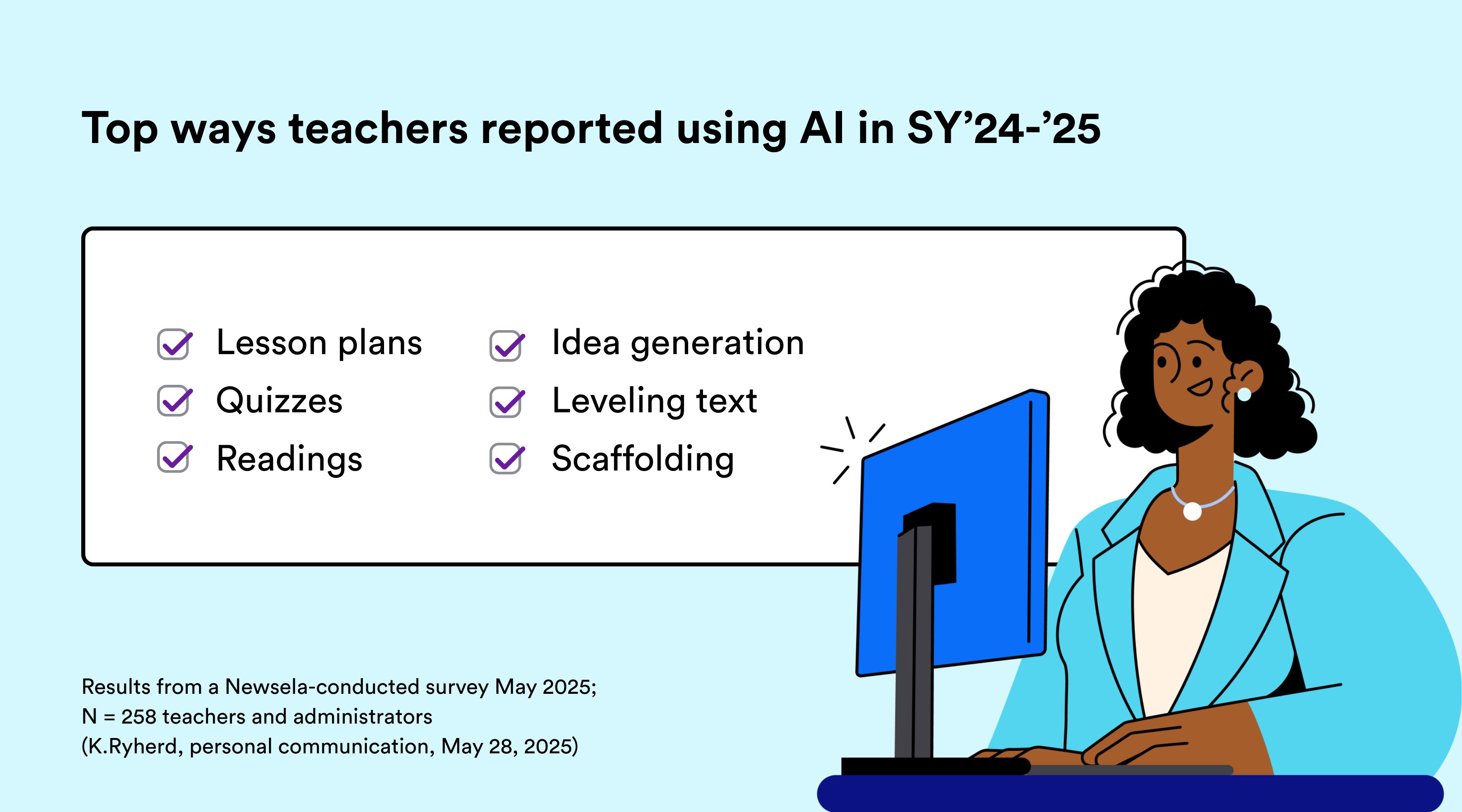
Amid all this use, the question becomes: How should educators evaluate AI? Thankfully, there is already a wealth of research and guidance from trusted organizations like Common Sense and Digital Promise based on decades of reviewing emerging technologies. Drawing on my own team’s pedagogical and technological experience, I want to add one more lens to that conversation: how educator expertise shapes the effective use of AI in the classroom. To support that work, here are three guidelines:
1. Ground every AI decision in your own professional judgment.
Before turning to an AI-powered tool, teachers need a clear sense of the instructional purpose and the expertise required to evaluate its output. AI can generate lessons, questions and scaffolds within seconds — but only educators can determine whether that content is accurate, instructionally sound and appropriate for their students.
Seek out tools that are transparent about where and how they use AI. This ensures that teachers retain full discretion on whether AI-generated content meets their own standards for quality and relevance.
2. When leveling text with AI, be an expert in the original.
One common way teachers use AI is to differentiate texts for multiple reading levels. Setting aside the broader discussion of why students need access to grade-level texts, consider what makes a good leveled text.
Done well, leveling involves both an art and a science — balancing quantitative measures like Lexile with qualitative aspects such as maturity, background knowledge demands, and organization. Leveled texts should help students access grade-level knowledge without compromising meaning or accuracy. Above all, this requires expert knowledge of the original. Review leveled versions carefully, consider how the AI has adjusted the content, and keep a close eye on what is retained and what is lost.
3. When creating classroom activities with AI, consider the expertise the task demands.
AI is sometimes compared to the agreeable graduate student: it can do a great deal of work, but it requires oversight. If you can’t picture how you might do the work yourself, it becomes difficult to evaluate the AI’s performance, especially when the output is unfamiliar or technically complex.
Just as you might hesitate to hire a graduate student from another department to complete research for you, approach AI tools with similar caution. When in doubt, look for tools designed for educators and developed by experts with deep understanding of pedagogy and classroom challenges.
Together, these guidelines reinforce a central idea: AI may speed up instructional tasks, but it’s educator expertise that ensures those tasks are meaningful, accurate and grounded in students’ needs.
The greatest resource we have is the expertise of teachers. If you’re less confident in your ability to assess the quality of outputs, seek out tools that are designed for educators and by education experts with a deep understanding of pedagogy and classroom challenges.
Now, more than ever, we need teachers to exercise their professional expertise in the oversight of new technologies. Let’s not give away our power to the machines. Our students need — and deserve — the guidance and judgment of skilled educators far more than they need digital solutions.
At the start of this school year, Newsela launched Luna, an AI-powered teaching assistant available across all our products. Our team developed a simple framework to ensure Luna’s machine learning models operate with the right context, behavior and educational grounding so its outputs are useful and safe for classroom use. To learn more about Newsela’s AI-powered solutions, connect with our team.
This article was sponsored by Newsela and produced by the Solutions Studio team.
Popular on EdSurge

Newsela is a leading provider of high-quality instructional and assessment products for K-12.
https://newsela.com
Read Next

News
Visual Arts
Voices of Change
Teaching and Learning


Voices of Change
Coding
How Coding Can Cultivate Deep Civic Engagement

News
Tutoring
Can High-Impact Tutoring Survive Post-Pandemic Funding Loss?


Voices of Change
Artificial Intelligence