Teaching Sex Education in Schools Is More Fraught Than Ever
December 5, 2025
Krystalyn Musselman holds a worn cardboard box up to the screen on our Zoom call. It’s the anonymous question box she relies on to field queries from high schoolers at Tecumseh Public Schools in southeast Michigan, where she teaches sex ed. The box, covered in pink and black patterned craft tape, is topped with a pink handlebar mustache, serving as a key visual set up for the “I mustache you a question” pun, which was popular about 15 years ago. Musselman acknowledges that this particular question box has been around for a while, and laughs. Clearly, the pun is still having its intended effect, as she’s fielding as many serious questions about sexual health as ever.
The question box remains a necessary tool for sex education instruction. It assures students’ anonymity while giving teachers like Musselman a direct line to the topics students are most curious about. She credits her students with asking great questions, but knows she must be careful in how she words her responses. This has always been the case; a 20-year veteran of sexual health in public schools, Musselman is well aware of her duty to adhere to state law and local district policies. She recently underwent the multistep process Michigan requires of the district to make lessons more current. The initial proposal included lessons on sexual orientation and gender identity, but she didn’t get approval for both.
“We do not actually teach or address gender identity or gender expression — that was something the curriculum review committee didn’t want,” Musselman said. “That was the give-and-take. We got a sexual-orientation lesson, but we didn’t get a gender one.”
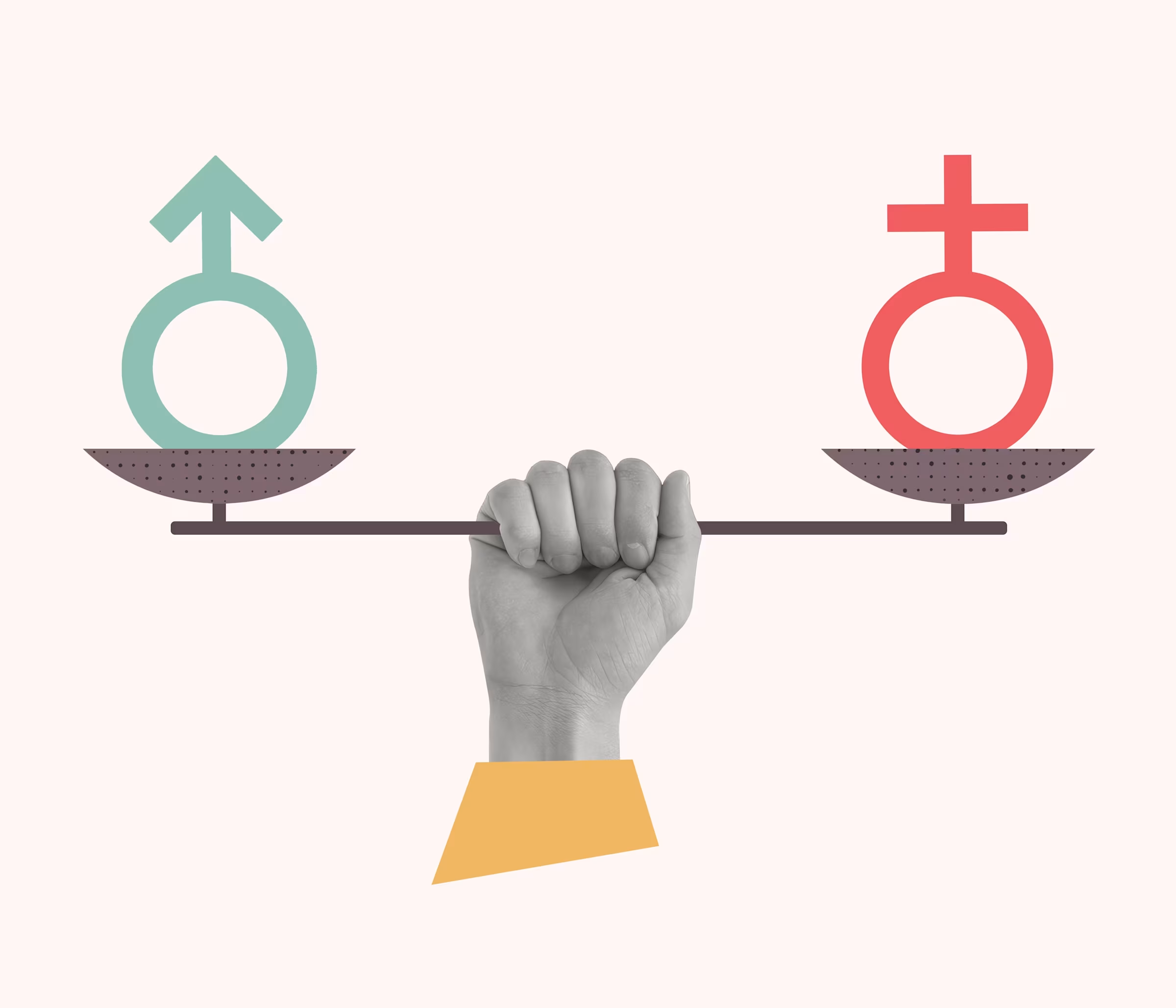
While always used to some controversy, sexual health educators are in an especially tough spot right now. Amid a push to update comprehensive curriculums to include lessons on sexual orientation and gender identity, state legislators are also considering laws targeting the people these changes help the most. Meanwhile, the Trump administration has threatened to pull funding from districts that don’t remove lessons on gender from their sex education curriculums. District responses have been mixed, with some states quick to issue statements indicating compliance, while some districts have resisted anti-LGBTQ+ rhetoric, at the risk of losing federal funding. Meanwhile some states have sued the U.S. Department of Health and Human Services.
The pressure to comply — and the resulting resistance — are illustrated by a recent fight in Michigan, which can be seen as a microcosm for what’s happening elsewhere. In November, Michigan’s Department of Education approved revisions to its health education standards. The revised standards covered a broad range of health education topics, from nutrition to mental health. And it included a recommendation that Michigan students be taught about sexual orientation and gender identity.
Taryn Gal, executive director of Michigan Organization on Adolescent Sexual Health, said the decision ultimately gives topics related to sexual orientation and gender identity more credibility.
“There’s now an opportunity for teachers to go to their school board or advisory board and be like, ‘This is the state guidance’,” Gal said. “It provides legitimacy that this is evidence-based, age-appropriate content that’s recommended by the state.”
How educators like Musselman will proceed remains to be seen. Though it ultimately passed, the new framework in Michigan was met with challenges from an opposition grassroots campaign similar to those that have been mounted against school boards in other states. The central, misleading claim of the campaign was that the proposed curriculum updates would strip parents of their right to opt their children out of sex education based on religious or moral objections. Gal found herself caught off-guard by the group’s unwavering commitment to the disinformation, lamenting that it hindered opportunities to have real conversations about the group’s primary concerns.
The purpose of teaching gender identity and gender expression, says Musselman, is purely informational — to provide context and clarity, and promote understanding.
“I think people are very scared and misinformed,” Musselman said.
More Opt-Outs
As philosophical and political arguments continue over the proper way to articulate concepts like gender identity and biological sex within the transgender rights discussion, sexual health educators are focused on the practical aim to educate students on basic human attributes.
The federal government has taken an aggressive stance against comprehensive sex education in schools. Trump officials threatened to revoke the Sexual Risk Avoidance Education (SRAE) program and Personal Responsibility Education Program (PREP) funding from states that mention gender identity in their curricula. This move politicized and created a false sense of urgency about what’s being taught by sex educators nationwide, and has had direct consequences, even in blue states like Maryland.
Laura is a sexual health educator in Maryland. EdSurge agreed to publish only her first name, because she feared retaliation from her school district for speaking with the media. She says she’s experienced an increase in discriminatory rhetoric reflecting homophobic and transphobic views from parents and students. Laura describes a significant increase in the number of parents requesting exemptions, which she began noticing in 2023. Before that, she estimates about 1 percent of parents opted their children out of her classes; now the rate is about 2 percent.
“So it’s not a huge percentage, but it’s definitely a 100 percent increase,” Laura said.
While Laura’s observation of a doubled opt-out rate may not be a “huge percentage,” some experts worry that challenges like those Laura has seen mean parents are really questioning the value of any sex education in schools. This is a problem, considering one in five adolescents say they received no sexual education from their parents, according to the Kaiser Family Foundation. Rachel Lotus is founder and director of The Talk NYC, an organization that partners with public schools in New York City to provide customized comprehensive sex education workshops and classes for youth, parents and schools. She says she’s noticed more emboldened rhetoric from the parents pursuing opt-out options for sex education.
“I had a parent in a high school who reached out — not to me, but to the school — to protest against broadening this framework of what sex is,” Lotus said. “The idea that I was talking about queer sex specifically was the objection.”
Lotus hasn’t received any gag orders from districts she works with; if she did, she said those districts wouldn’t be worth partnering with to begin with. She notes that in a city like New York, it’s hard to conceive of a world in which students can unlearn inclusion.
“I have fourth graders who absolutely understand the difference between biological sex and gender identity,” she said. “I am not introducing those ideas [to them] for the first time.”
Historical Precedent
Major public health organizations, such as the World Health Organization, follow peer-reviewed research suggesting that sexual health education curricula is most effective when it covers a range of topics, and remains adaptive and sequential. Sex educators agree.
Despite these findings, incorporating comprehensive sexual health education in public schools has remained inconsistent because there is no federal mandate for sex education in schools. Instead, curriculum is determined at the state level. And districts within a state can differ widely in what they do and don’t teach. The closest the U.S. ever came to endorsing sex education in public schools was through the Personal Responsibility Education Program. Established in 2010 as part of the Affordable Care Act, PREP mandated the abstinence-plus approach, which meant including information on both abstinence and contraception in curriculum. PREP ended the abstinence-only-until-marriage model that preceded it.
Historically, teaching sex ed in public schools has been fraught from the beginning. Margaret Grace Myers, author of “The Fight For Sex Ed: The Century-Long Battle Between Truth and Doctrine,” published in August, said the framework for sex education in public schools was limited to discussion of gender identified at birth and sex between men and women only.
“When we first had ideas about sex ed — variously called social hygiene or personal purity or sex hygiene — of course historians know that LGBTQIA+ people have always existed and will always exist, but it was not even a thought that crossed the minds of anybody who was thinking about instructing young people in sex,” Myers told EdSurge. “The lesson was basically stay abstinent, do not have sex, get married, and the person you would marry would be of the opposite gender, and then only have sex with that person. That was the framework that worked as a disease-prevention angle, which is why doctors were able to get behind it.”
The 2015 documentary “Sex(ed): The Movie” uses archival film clips to show how sex education films shown in schools and in public tended to model relationship dynamics that may have been aspirational at best. The footage presents an image of the world that’s missing a lot of context and is unreflective of reality. This is because the old films weren’t designed to teach but to uphold societal norms, Myers says.
In areas of the U.S. where comprehensive sex education is taught, conversations about gender identity and sexual orientation didn’t become part of the curriculum until the mid- to late 2010s.
“Even for people who are getting the best curriculum available, it might not be relevant to them almost at all, which is wild,” Myers added.
Only nine states require gender identity and sexual orientation be covered in comprehensive sex-education classes, according to the Sexuality Information and Education Council, known as SIECUS, a 60-year advocacy group for sex ed in schools. Its series of heat maps show how nearly half of states received a “D” or “F” in how LGBTQ+ sex ed topics are handled. Similarly, a 2025 Guttmacher policy report highlights that only 26 states require sex and HIV education be medically accurate, while 10 states have broad laws prohibiting classroom instructions on these topics and seven still have laws explicitly requiring same-sex discussions be depicted negatively, if at all.
Sex education in Mississippi, a state that is legally bound to a strict abstinence-only or abstinence-plus requirement, does not cover sexual orientation or gender identity. Yet, according to Josh McCawley, deputy director of Teen Health Mississippi, those topics are what students have the most questions about. The organization is responsible for providing professional development to sex-education teachers in the state.
“In all of the curricula, there’s no actual written information on LGBTQ-related issues,” McCawley said. “However, in our training that we do with teachers, we have learned that this is pretty much the most popular topic for student questions.”
Miranda Estes, state policy action manager for SIECUS, says when it comes to the state of sex ed in American public schools, regional considerations matter.
“I think about Mississippi and it breaks my heart,” Estes said. “But [Mississippi] is 50 years behind in policy from places like Massachusetts, and so trying to jump the gun and say these organizations need to be providing comprehensive sex education in public schools when they’re not even legally allowed to, could it go wrong?”
It is well-documented that LGBTQ+ youth, particularly trans students, are more likely to experience bullying and to attempt suicide. Zach Eisenstein, director of communications with the Trevor Project, said the majority of LGBTQ+ youth report the political environment taking a measurable toll on their health and well-being.
“At The Trevor Project, our crisis counselors regularly hear from young people, especially transgender and nonbinary youth, who share how the onslaught of anti-LGBTQ+ policies and rhetoric are negatively impacting them,” Eisenstein told EdSurge in a statement, noting that welcoming school environments can serve as a lifeline for at-risk youth. “LGBTQ+ students who said they learned about LGBTQ+ people or issues in the classroom reported 23 percent lower odds of attempting suicide in the past year, compared to those who did not.”
Addressing Discrimination
It’s standard practice for a sex-ed teacher to screen questions submitted anonymously by students in the question box. Musselman in Michigan’s Tecumseh Schools finds that students generally ask insightful questions. But Laura in Maryland has been fielding more discriminatory questions and comments within her classes.
“They’re questions that kind of mirror what we’re hearing from adults, honestly,” she said.
She tries to transform these queries into teachable moments. Her approach involves two key strategies: Using first-person language that students can then mirror, and advising students not to submit the first question that comes to mind, but the second. Her theory is that the second question is the one her students are actually curious about; that it’s far more interesting and less likely to be informed by prejudices picked up from outside sources.
These strategies are crucial for Laura, seeing as the ultimate goal is to prevent students from being pulled out of the entire sex-education curriculum. In Maryland, where Laura teaches, opting a student out means they miss instruction on not only gender identity and expression, but also on vital topics such as consent, contraception, disease prevention, health relationships, and sexual decision-making. Basically everything else that sexual health encompasses.
“Sometimes we’ll have parents who say, ‘I just don’t want them to learn about gender’ or ‘I just don’t want them to be exposed to the transgender ideology’,” Laura said. “But when I talk to them about why they want their child excluded, it’s because they want them to sit out that one lesson and not from the broader unit.”
Maryland doesn’t mandate one uniform opt-out policy for Family Life and Human Sexuality units. Those details are left up to local decision-makers, although most of the districts in Maryland have adopted an all-or-nothing approach toward sex ed. Because Laura works for one of those districts, she finds herself on the phone with parents who have knee-jerk reactions to certain topics based on preconceived notions that may or may not be accurate. In these cases, it’s her job to explain what the lesson entails, what resources she’s using to teach it, and the education their children will lose if they’re opted out of sex ed entirely.
“I have about a 50-percent success rate of parents being like, ‘You know what? Actually, that’s fine. Go ahead and include them. I think it’ll be OK’,” Laura said.
Claire Woodcock is a freelance education journalist specializing in information access and restrictions, privacy and civil liberties.
Correction: This story has been updated to correct references to Zach Eisenstein and LGBTQ+ self-harm statistics.
Popular on EdSurge
Read Next

News
Visual Arts



Voices of Change
Artificial Intelligence


Opinion
Artificial Intelligence
Will Kids Pay the Price for AI Panic?

Voices of Change
Artificial Intelligence