Finding Our Way Forward: The Struggle and Promise of AI Literacy
Preparing students for an AI-driven future requires prioritizing the human qualities and values we cannot afford to lose along the way.
November 4, 2026

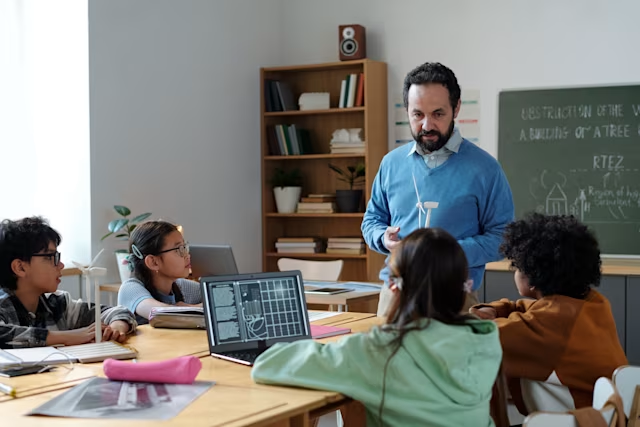
Credit: Panchenko Vladimir / Shutterstock
To be honest, I was reluctant to write this article. That sounds like an odd place to start a conversation about artificial intelligence in education, especially for someone whose work includes developing AI literacy curriculum for students. But the truth is, I’m exhausted.
As school technology leaders, we feel immense, unspoken pressure to have all the answers. We must reassure parents, guide teachers and protect our students, while technology shifts beneath our feet on a weekly basis. Often we’re writing policies to govern the use of tools that will be updated or replaced by the time the policy is approved.
Trying to manage the ethical, moral and legal implications of AI in schools feels less like an exciting frontier and more like standing in the middle of a dodgeball circle, waiting for a hit without knowing where it will come from.
But my fatigue has even deeper roots. It is inextricably linked with the community my school serves and our mission to ensure the frantic pace of AI does not overwrite the Indigenous values crucial to our students’ development. It is an overwhelming conundrum.
Rooted in Community Values
At the Indian Community School (ICS), a private, faith-based, intertribal school in southeastern Wisconsin, everything we do is rooted in a profound responsibility to both the natural world and future generations. Fulfilling that responsibility requires us to introduce AI technology with a fundamentally different approach than many other schools.
Too often, the national conversation focuses on whether students should be allowed to use AI, rather than on what they need to know to live responsibly in a world where AI is everywhere. Understanding how the technology works must come before using it.
At ICS, students begin learning about artificial intelligence before they are given access to AI tools. As early as second grade, our students explore how machine learning systems recognize patterns, how training data influences what a program produces and how bias and hallucinations can shape its outputs. Through these offline investigations, which can be as simple as sorting buttons into categories, young children begin to recognize that AI systems are only as reliable as the data used to train them.
Button-sorting is a simple, tactile activity that prompts students to collaborate and communicate as they determine categories for their buttons and defend their placement decisions. By challenging students to find various ways to group the buttons based on different features (such as size, color or shape ), the exercise simulates how human developers label data for training artificial intelligence.
Students also must identify ambiguous buttons that might “confuse” a machine during training, showing them the importance of high-quality, clearly defined data. Ultimately, this offline activity serves as the perfect foundation before students move online to collect and categorize real data to build their own machine learning models.
By middle school, our students extend their learning to examine data sovereignty, privacy and the environmental costs of the digital infrastructure that makes AI possible. This progression builds the critical thinking skills students need to evaluate whether, when and why using a particular AI tool is appropriate.
In sixth grade, after completing these foundational lessons, students are given access to AI tools within a teacher-guided framework. They have the autonomy to approach their teachers and request access to a particular tool when they believe it could support their learning.
Teachers consider the purpose of the task and determine whether access is appropriate, whether that’s for research, writing feedback, idea generation, image generation or another specific learning activity. Access isn’t automatic or unlimited; it’s an opportunity for students to apply what they’ve learned in a purposeful way, with teacher guidance and appropriate boundaries.
Rather than beginning with access to AI and hoping students learn to use the technology responsibly, we build a strong foundation first. Our goal is to develop students who can make informed decisions, including recognizing when an AI tool adds value, when its limitations matter and when the best decision is to walk away.
Weighing the Pros and Cons
Understanding AI also means looking beyond what the technology can do to consider what it requires from our environment and how it impacts people. When evaluating a new technology, it is easy to focus on the immediate, measurable benefits: cost, privacy, efficiency and the potential to improve teaching and learning.
If an AI platform saves teachers time or helps students learn something more quickly, those benefits are easy to recognize. The environmental cost of the servers needed to power the technology, however, is much less visible.
But as a technology leader at an Indigenous school, I do not have the option to ignore environmental costs. My role is guided by a deeply felt responsibility to thoughtfully navigate the adoption and use of AI in a way that aligns with our community’s commitment to sustain the natural world for future generations.
This is not an abstract concern for us. Wisconsin is rapidly becoming a hot spot for hyperscale data centers. Massive facilities in places such as Mount Pleasant and Port Washington require thousands of acres of land, up to 1.3 gigawatts of power and millions of gallons of fresh water. Data centers currently operating and proposed in the U.S. will require enormous amounts of energy and water.
Recent estimates project that, by 2028, AI-related data centers in the U.S. could require up to 32 billion gallons of water annually. We want students to consider not only the benefits of the technology they use, but also how today’s choices about providing the natural resources the technology requires affect their community now and will affect future generations.
When students investigate data center development in Wisconsin and the surrounding region, we ask them to look beyond a map of proposed or existing facilities and ask important questions, such as these:
Why are the locations chosen?
What resources make them attractive to developers?
Who benefits economically, and who bears the environmental or community costs?
Whose perspectives are included in the decisions, and whose might be missing?
Have Native Nations in the region had a meaningful say?
How are tribal lands, water and treaty rights expected to be impacted?
By working through questions like these, students begin to recognize that technology is never entirely separate from the people, places and resources needed to sustain it.
The Limits of Convenience
Even with a strong foundation in AI literacy, we can’t lose sight of what meaningful learning requires. Students need opportunities to struggle with unfamiliar ideas, test their thinking, make mistakes and learn through feedback that challenges them to grow. There is value in not knowing the answer right away and having to consider a new approach.
When students can use a chatbot too quickly to provide an answer or complete a difficult task, they can miss the very thinking we want them to develop. The question isn’t simply whether AI can make learning easier, but whether making it easier serves the learning we value.
That doesn’t mean AI has no place in the learning process. Our middle school literacy teacher, for example, has students use a vetted AI tool to gather specific feedback on their writing as part of a broader approach that includes feedback from peers, teachers and the greater school community.
Students learn how to write prompts that ask for feedback on elements such as structure, grammar, clarity of message, tone and organization. Just as importantly, they are taught to establish boundaries for that feedback. Rather than asking AI to rewrite or improve their work, students ask the tool to identify potential areas for revision and provide bulleted suggestions they can consider.
This creates opportunities for students to practice evaluating feedback rather than simply accepting it. A student reviewing a chatbot’s suggestion to revise a paragraph, for example, may pause and weigh the recommendation against their original intent.
They might decide to incorporate part of the suggestion, reject it altogether or rewrite the sentence in their own voice to preserve their argument and maintain authenticity. The decisions about what to change, what to keep and how to revise remain with the student.
In this example, AI serves a specific, limited purpose within the process but doesn’t replace the perspectives, relationships and conversations that help students become stronger writers. Students still need to consider feedback, decide how to use it and take ownership of their revisions. The goal isn’t to remove every obstacle or provide students with an immediate answer. It’s to give students opportunities to think critically about the feedback they receive and use it to grow.
We also have to be mindful of what students need from the people around them. While it is tempting to use AI to fill the gaps left by our overstretched educational systems, we must recognize its limits. A chatbot that responds with apparent patience and affirmation may seem more approachable than a teacher or classmate, but being agreeable isn’t the same as helping someone grow.
Learning requires more than an answer that sounds right or a response that makes us feel good about our thinking. It requires relationships with people who know us, challenge our assumptions and help us navigate the discomfort that sometimes comes with learning something new. We have to be careful not to let the convenience of AI come at the expense of those relationships or the opportunities students need to develop independent judgment.
What AI Might Undo Along the Way
Preparing students for a world where AI is everywhere means helping them understand not only what the technology can do, but what it might undo within themselves and their communities.
I do not have a neat answer to every question AI raises for schools. The evidence is developing, and the implications reach far beyond what any individual school can control. But uncertainty doesn’t absolve us of our responsibility to make thoughtful decisions.
At ICS, that means thinking beyond what is convenient today and considering what our decisions mean for future generations. While ICS’s approach is rooted in our Indigenous values, I believe this framework offers value to educators across schools, institutions and learning communities navigating the AI revolution thoughtfully.
AI literacy cannot simply mean preparing students to use whatever technology comes next. It must also mean helping them recognize when a tool serves their learning, when it gets in the way and when consequences extend beyond individuals. We have to give students the time and space to think independently, learn from one another and develop the judgment to make those decisions with care.
We may not be able to predict the next hit in this dodgeball game, but we can let what we already stand for guide our response. Preparing students for the future isn’t about teaching them to keep up with every technological change. It’s about helping them meet those changes with critical thinking, a sense of responsibility to others and the confidence to decide what deserves a place in their lives.
This story is part of an EdSurge series chronicling educator experiences. These stories are made publicly available with support from Learning Commons. EdSurge maintains editorial control over all content. (Read our ethics statement here.) This work is licensed under a CC BY-NC-ND 4.0.
Popular on EdSurge
Read Next

Opinion
Artificial Intelligence
Pause AI in Schools. But Not Before You Do This First.

Opinion
Artificial Intelligence
Will Kids Pay the Price for AI Panic?

Voices of Change
Artificial Intelligence
Why AI Made Me a Better Principal

Voices of Change
Artificial Intelligence