Rethinking What We Choose to Measure in Schools
In the push for accountability, this educator grapples with information overload and diminishing classroom time.
December 17, 2025
Utoimage / Shutterstock
Sitting in a recent district administrator meeting, I found myself excited about a new student data platform my district is rolling out. This new tool, called by a catchy acronym and presented on a flashy dashboard, would collect a variety of information about student skills, mindsets and achievement. It would let us break down information by subgroup and assign overall scores to students, helping us identify who needs additional support.
Initially, I was enthusiastic about how it could empower teachers to better understand students and improve outcomes. But since then, after conversations with the teachers in my building and reflecting on my own experiences using data in the classroom, I’ve begun to wonder whether we are focusing on the wrong data or placing too much emphasis on data overall.
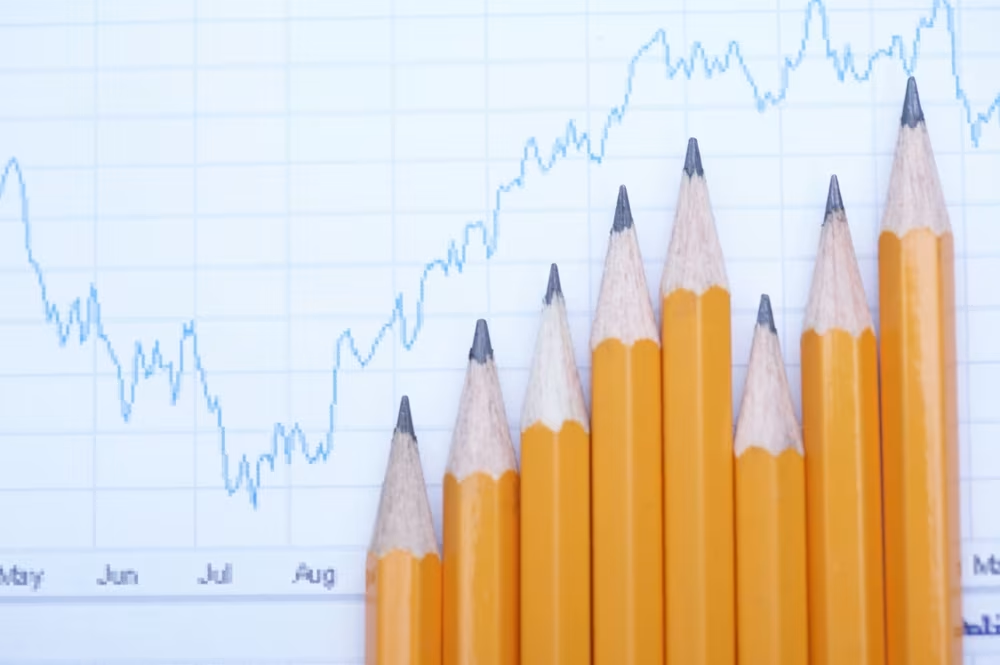
I love looking at data. I’m excited when data surprises me or shows me something more clearly. It’s motivating to see trend lines sloping upward and green arrows pointing toward the sky. Data can help us see the bigger picture when looking at larger systems. We can see which schools are suspending too many students of color and which districts are improving reading scores. As an administrator, I find this illuminating and helpful in guiding how schools make decisions.
But as data trickles down to classrooms and individual students, the usefulness and impact get murkier. In the Montessori school where I teach, where our focus is guiding the child according to their interests and readiness, the data we have to collect affects what we focus on, often in unexpected ways, and sometimes to the detriment of the system itself.
Teaching to the Test
My school is a successful one, and looking at our annual school report card should be a source of pride for the teachers. The report card is based primarily on our state test scores in math and reading, and various calculations are made from our students' performance on it. But when we shared the most recent report card that showed our school once again exceeded expectations, the results were met with shrugs and muted applause. It isn’t that they aren’t proud of what our students can do; they just recognize the narrowness of the data and how indirectly it connects to what is happening in their Montessori classrooms.
When I pointed out that our report card showed math achievement was an area for improvement, the response was, “Are you saying we should teach to the test?” They know that we could game the system by focusing on test prep and the specific questions their students might encounter. Because we follow a Montessori curriculum with three grade levels in our classrooms, our sequence doesn’t always align with grade-level standards, which can show up on tests, with students scoring poorly on topics they haven’t been introduced to yet. We could align our curriculum with the test and focus our teaching on what the test assesses, but doing so goes against our philosophy of allowing students to make choices about their learning at their own pace.
With this tension in mind, I wonder if data distorts the focus of education? Our current focus on reading and math scores, based on standardized testing, is part of what we want our schools to do. But teachers know that students are capable of achieving much more than our report cards show. Is there some golden indicator that we just haven’t found yet — a measurement like happiness or flourishing — that would be more meaningful? And of course, if we find it, won’t it also become distorted?
Information Overload
I’ve seen amazing teachers, skilled at connecting with kids and providing rich learning experiences, brought to tears because there was too much red on a data spreadsheet.There is also a heavy focus in our district on using data to determine which students qualify for additional support through differentiation, interventions and individualized instruction. Administration requires us to hold monthly meetings to review student data and determine who is progressing and who might need more support. On one level, this seems like a great practice for identifying who needs help, but in reality, the system’s capacity to act on that information is overstretched, leading to distortion and ultimately to burnout.
I remember my frustrations as a teacher in these meetings. The data was interesting and could help you to confirm or question ideas you had about students based on your classroom observations. But it didn’t often provide helpful information for supporting students. The time spent in these meetings outweighed the benefit I got from them, and took away from the little time I had to prepare and plan for my students.
NEWSLETTERS
STAY AHEAD IN EDUCATION.
Sign up for EdSurge newsletters for timely news, insights and analysis.
Teachers I work with have regularly expressed feeling overwhelmed by the amount of information they need to consider and the testing required to gather it. In our early grades, due to a new state law mandating early literacy assessments, students are tested monthly on letter-sound identification and oral reading fluency. This generates an unending stream of data to grapple with and a constant feeling of needing to do more to address it, all of which adds to stress on teachers, students and the system. I’ve seen amazing teachers, skilled at connecting with kids and providing rich learning experiences, brought to tears because there was too much red on a data spreadsheet.
Teachers don’t have the time to assess and examine all the data they're now expected to, and monthly checks of early reading indicators take time away from actually teaching those skills. Being responsive to the data you gather means stopping what you’re doing and finding new ways to help kids learn what the data says they need. Teachers are expected to find new resources and determine when and how to work with small groups that need similar support, while also providing meaningful learning opportunities for other students. And, of course, different kids need different things, so you’d need to do this for multiple groups, which is unrealistic to expect all teachers to have the capacity to do.
Meaningful Measurement
Schools, as they are currently designed, weren’t supposed to be responsive to the amount of data we’re collecting. They were designed to teach a group of students a set of information in a specific sequence each year, and then grade them on how well they learned what they were expected to learn. They were designed to tell us which students could meet the standards, and who couldn’t, not to ensure that each child could learn and flourish.
When I was a classroom teacher, I kept track of how many books my students read each month. It wasn’t research-backed or scientifically valid, but I found the data helpful for identifying who was and wasn’t reading, and thinking about how I could support them. In some cases, it helped me direct kids to books that they might get excited about; in other cases, it just let me know that a particular kid wasn’t that into reading, and that that might have to be OK for now. The data wasn’t complicated, but it let me quantify what I was observing in my classroom in a way that was meaningful to me and, most importantly, helped me connect with my students as whole people.
A key component of Montessori philosophy is the teacher as observer — watching and documenting what students choose and do to understand and assess what they are ready for. Every teacher should have the time and space to measure and track what feels meaningful and helpful to them.
This may look different for every teacher, but the important factor is that it has meaning to them and is connected to their students and their practice. Likewise, we need to remember that standardizing the expectations for students goes against what we know about how people develop. There’s always going to be variation in a dataset — there’s no metric on which we are all the same.
As an administrator, my responsibility is to understand and use data in ways that are helpful, while also protecting teachers and students from distractions and distortions that undermine the larger goals of creating opportunities for growth and learning for all students.
Ultimately, data should serve as a guide rather than a governor, informing our decisions without eclipsing the human elements of teaching and learning. If we can strike that balance, we can create systems that honor both the complexity of children and the professional wisdom of the educators who know them best.
This story is part of an EdSurge series chronicling educator experiences. These stories are made publicly available with support from the Chan Zuckerberg Initiative. EdSurge maintains editorial control over all content. (Read our ethics statement here.) This work is licensed under a CC BY-NC-ND 4.0.
Sachin Pandya (he/him) is the assistant principal of Goodland Montessori in Racine, Wisconsin.
Popular on Edsurge
News
Hundreds of Thousands of Eligible Kids Are Waiting for Childcare Assistance
Moriah Balingit and Lauren CoffeyNews
A Principal and a Student Reviewed the New ChatGPT for Teens. They Had Plenty to Say
David WeldonRead Next

Scenes From College Classes Forced Online By COVID-19



News Exclusive
Personalized Learning