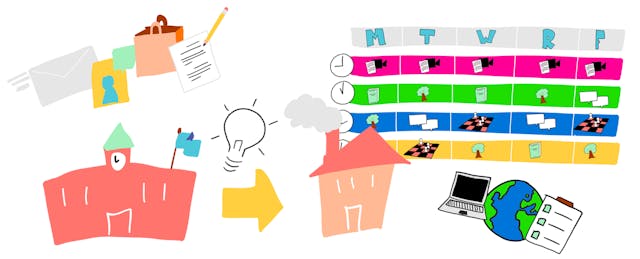
As schools shift to remote learning models for the foreseeable future, parents and caregivers are finding themselves in a new role—that of the school co-teacher. Though parents are naturally a part of their children’s ongoing education, co-teaching is a new role for many of them.
Frankly, it’s a new role for us (Reshan and Steve) as well, so when it came time for us to pursue our curiosity about how parents and caregivers can best provide hour-to-hour care, we turned to an expert.
Beth O’Brien, head of early childhood at New Canaan Country School in New Canaan, Conn. (and also one of Reshan’s colleagues) exudes positivity, warmth and a bone-deep knowledge about the best ways to nurture our youngest learners toward growth. Her counsel leads what follows, and makes thinking processes and plans accessible to others who may be wrestling with similar questions.
The General Approach

Student well-being is our priority. For three-year-old to six-year-old students, daily points of connection with their school teachers will be most important. Whether the method is digital (email, video) or physical (material packets for pick-up, mailed letters), these connections will need to be mediated by parents or caregivers. Short greetings—which can be text, audio, video or some hybrid of the formats—can be followed by invitations to and ideas for follow-up engagement with a grownup at home.
Our goal is not to replicate a typical school-day schedule or intended curriculum online or at home. The goal is to help students continue to feel connected (to the teacher, to each other, to the school), known, and nurtured even though a significant part of their routine has been disrupted. Any cognitive, social-emotional, physical, and moral development that is woven into the new routine is not a reaction to some external pressure to “complete the curriculum.” Instead, these dimensions should be interwoven and even prioritized because they are best for children’s development at these ages, regardless of the setting.
We have messaged the following to teachers, and we believe the same should be true of parents and caregivers who are asked to be a bigger part of their children’s formal education than they may feel prepared to do:
1. Competency will build over time. Give yourself time and space to improve in your role as your child’s instructor, and give your child time and space to develop as an at-home learner.
2. Everyone has permission to embrace a “beginner’s mindset.” To be adaptable, flexible, and willing to make mistakes. A sense of humor will be helpful here as well. Our commitment is to growth and possibility (in remote teaching for teachers, in early childhood teaching for parents and caregivers.)
3. Young children are naturally inquisitive and driven to explore, discover, tinker and test. They are always learning. This shift to 'school at home' will offer you a chance to observe that learning in a new way. Rest assured, development is development is development. Just be present for it. (One of our mentors once said to one of us that she could tell that an early childhood teacher was going to be successful if he or she was willing to sit on the floor with the students.)
4. Ease into things. The first 5 days don’t need to look like the next 5 which don’t need to look like the 5 or 10 after that.
5. Prioritize what you need to run your household and remain holistically healthy. Work, childcare, meals, checking in on other family members, etc. will require your attention.
6. Focus on self care. It’s like the oxygen mask in the plane analogy — make sure yours is functioning before helping others.
Examples of Guidance for Teachers
Because our classroom teachers will be the primary contact with students via their caregivers, it is important to understand the types of things we are trying. These are examples of guidance provided to teachers of 3 to 6 year olds who will be working with parents and caregivers to bridge the time between when the school building is closed and when it is accessible again.
For communication channels, we don’t assume that the ones that were effective while school was open will have the same exact impact when it is now closed. Or at the very least, we don’t assume that the way those communication channels were used will be exactly the same. Face-to-face contact, between teachers, students and sometimes caregivers while school is open, allows for constant clarification and negotiation. But when one cannot count on seeing the child or caregiver in person, the need to effectively convey clarity, tone, emotion, and priority are all therefore amplified..
Communication channels include:
- Teacher email
- Phone calls
- Face-to-face (planned and informal)
- Course and class webpage
- Text messages
- Parent representative emails
One helpful exercise suggested by our friend Helen Noble from Montclair Kimberley Academy in New Jersey is to look at all of the communication channels and instructional approaches used when school is open and consider the affordances and limitations that are newly introduced when you cannot count on face-to-face, in-person contact with children and their caregivers. Being this deliberate at the outset will serve your plans as you ease into or sharply enter a school closure plan.
For example, the lower grades at her school use Weebly as the main mechanism for sharing newsletters, photos and other class happenings with families. They have also been using the Seesaw platform for digital portfolio work in recent years. In their analysis, they are wondering if they’ll pivot more of their communication to the Seesaw platform because 1) they feel they addressed connectivity needs across their families and 2) many of their remote instructional ideas will be better served directly through that platform.
Pre-K Teachers may …
Send a daily email at 9:00 a.m. with the following content:
- A video with a warm friendly upbeat greeting and the plan for the day as well as a few suggestions for activities.
- Morning meeting video and an invitation for a follow-up activity.
- Read-aloud video along with favorite fingerplays and songs
- Consider the possible technologies available to the family: Ask the parent or caregiver to document the child’s work through a photo or a short video in order to stay connected to the child’s learning experience.
Kindergarten Teachers may …
Send a daily email at 9:00 a.m. with the following content:
- A video with a warm friendly upbeat greeting as well as a brief overview of the plan for the day.
- Morning meeting video and an invitation for a follow-up activity.
- Lesson videos or prompts in the following curricular areas: reading, math, writing, and social studies.
- Activity prompts that can be done throughout the day.
- Consider the possible technologies available to the family: Ask the parent or caregiver to document the child’s work through photos or a short video in order to stay connected to the child’s learning experience.
Specialists (i.e. Science, Art, Music, Spanish, Motor, Materials, PE, etc.) may …
- Record one video each week for each grade level. Upload the video to the Google shared drive and the homeroom teacher will send the link in the daily email.
- Create a list of additional activities for the children to do at home.
Preparing a Setting at Home

Here are some ways to prepare space and practice behaviors for follow-up engagement:
Set up an indoor space where learning activities happen in your home. Collaborate with your child about where “school will happen” and what materials will be needed. Set up a place where your child can reach needed supplies such as paper, a clip board, scissors, pencils, crayons, tape, etc.
Children love to be helpers. They want to contribute, and they thrive when they feel a sense of accomplishment. After watching a teacher video or reading a prompt, invite your child to help you collect materials needed for the activity.
As children are working, hold space in your own schedule just for them. Describe what you see. Focus on effort. Name progress. Ask questions.
- Be present: Proximity is our most powerful gift. An encouraging smile or a supportive nod will be reassuring.
- Describe what you see: You found all the blue and green unifix cubes and now you’re making a pattern. That block building is tall. You used a lot of purple today. You did it!
- Focus on effort: You kept going even when you were frustrated. You stuck with it when you were unsure.
- Name progress: You’ve done three. You have two more to go.
- Ask questions: Tell me about it. I wonder what will happen next? What’s your idea?
If possible, document your child’s work. Take a photo. Record a short video. Keep a journal of what you are observing.
Consider transitions. Flow, pacing, and movement are vital to a young child’s learning. After a focused activity, have children move: run around outside, do flips on the couch, engage in self-directed play.
Rhythm and Routine at Home

Consider the power of routine and rhythm as an anchor to your child’s “school days.” Create a daily schedule based on what the school teacher sends (whether the message is daily, every other day, weekly, etc.). Have your child help draw pictures or write labels so they can see the plan for the day. Provide as many links between home and school as you can to help your child orient and activate prior knowledge of classroom routines.
Here is a home “school schedule” to consider:
- Breakfast followed by morning routine: get dressed, brush teeth, complete morning chores, etc.
- Self-directed play: mirrors morning arrival choice time
- Lesson & follow-up
- Snack & Outdoor time
- Self-directed play or set materials from a teacher activity prompt for the child to explore and create: mirrors daily choice time
- Daily read-aloud video
- Lunch
- Quiet Time: audio books, quiet music, rest: mirrors a familiar routine from school
- Specialist Video and activity prompt
- Outdoor time
- Morning Meeting video: greeting, do-with-me movement activity, ideas for the day
Home ‘School’ Activities

The following is a list of activity suggestions for 3-6 year olds during a time of remote learning. The materials mentioned — crayons, books, pipe cleaners, and so on — could be good items to put in a “pick-up” or “send-home” bag for those families who may not have access to them.
Emergent Writing
- Keep paper, pencil, crayons and markers handy
- Model writing: lists of things to do, groceries to buy, activity plans or thank you notes
- Journal time: find a moment each week for your child to dictate reflections, ideas, a story, small moments you are thankful for
- Draw pictures and write letters to friends and family. Add an address to an envelope, a stamp and head to the mailbox
Language Development
- Read together every day: fiction, non-fiction, fairy tales, poetry
- Read street signs together
- Word games in the car: travel bingo, 20 questions, sequential memory stories (ex: I went on a picnic and I brought ___________)
- Dinner table discussions and conversations
- Oral rhyming — when reading books with a rhyming cadence, stop before the second rhyme to bring your child’s attention to the pattern
- Tell stories using first, then, next, last
Gross Motor
- Outdoor fun: bike, scooter, trike, run, jump, hop, skip
- Sidewalk chalk
- Play hopscotch
- Create a balance beam with tape on the floor
- Crab walk, bear walk, wheelbarrow walk
- Paint the driveway, rocks, concrete steps with big brushes and water
- Shaving cream play in the tub or on an opened dishwasher door (makes clean-up a breeze!)
- Sort or fold laundry, empty the dishwasher, set the table
- Finger paints
- Build in the sand on the beach or in a sandbox
- Dig or pull weeds in the garden
- Plant seeds and water outdoor plants
- Hammer nails into a piece of wood
- Jump rope
- Throw and catch large balls
- Indoor obstacle course
Fine Motor
- Water houseplants with spray bottles
- Scissor work: cut strips, fringe, or pictures from magazines
- Make play dough
- Legos and Duplos
- Cooking: stir, crack eggs, grate cheese by hand, use a hand eggbeater
- Beading
- Finger puppets
- Pick up things with tweezers
- Simple sewing andweaving
- Pipe cleaners
- Build playing card houses
Math
- Collect, sort and classify seashells, stones, pinecones, small sticks, flower petals, baseball cards, etc.
- Play board games: Snail’s Pace Race, Harvest Time, Hi-Ho Cherry-o, Blockus, Trouble, Chutes and Ladders
- Count everything: plates, napkins, cups, socks from laundry, houses, buttons on shirts, toys during clean-up, silverware as you unload the dishwasher
- Cook, measure
- Identify numbers: telephone numbers, numbers on mailboxes
- Puzzles: mazes and jigsaw
- Car activities: find shapes, numbers in the environment
- Card games: go fish, war, rat a tat cat, memory, UNO
Online Curricular Resources

These are just a few of the many resources that parents and caregivers can look to in support of their children’s experiences.
- Art & Play Activity Guide: A weekly art and play activity guide for learning at home for children ages 3-8.
- Other Goose: Homeschooling resource for families of children 2-6 year olds focusing on open-ended discovery.
- Sparkle Stories: Audio stories and activities for children ages 3-12
- Nature on PBS: Documentaries that illuminate the wonder and beauty of the natural world
- WOW in the World: NPR Podcast for curious children, ages 5-12 and their grown-ups
- TinkerLab: Art, science and tinkering guides for parents with children ages 2-12
Parenting Resources for COVID-19
These are some resources for talking with your children about COVID-19
- Talking to Kids About the Coronavirus
- Why Are People Wearing Masks?
- Soap & Germs Experiment
- 5 Ways to Help Children with Coronavirus Anxiety
There is a lot of newness these days. As you face new challenges, remember that competency will build over time. Be adaptable, flexible and willing to make mistakes. Consider that being present can often be enough. Ease into things. Prioritize what you need to run your household and remain holistically healthy. And don’t forget to take care of yourself.