On AI Policy, Students Have Plenty to Say
At a gathering in Boston, ‘student senators’ proposed a first-of-its-kind national AI policy for K-12 classrooms.
By David Weldon
August 13, 2026
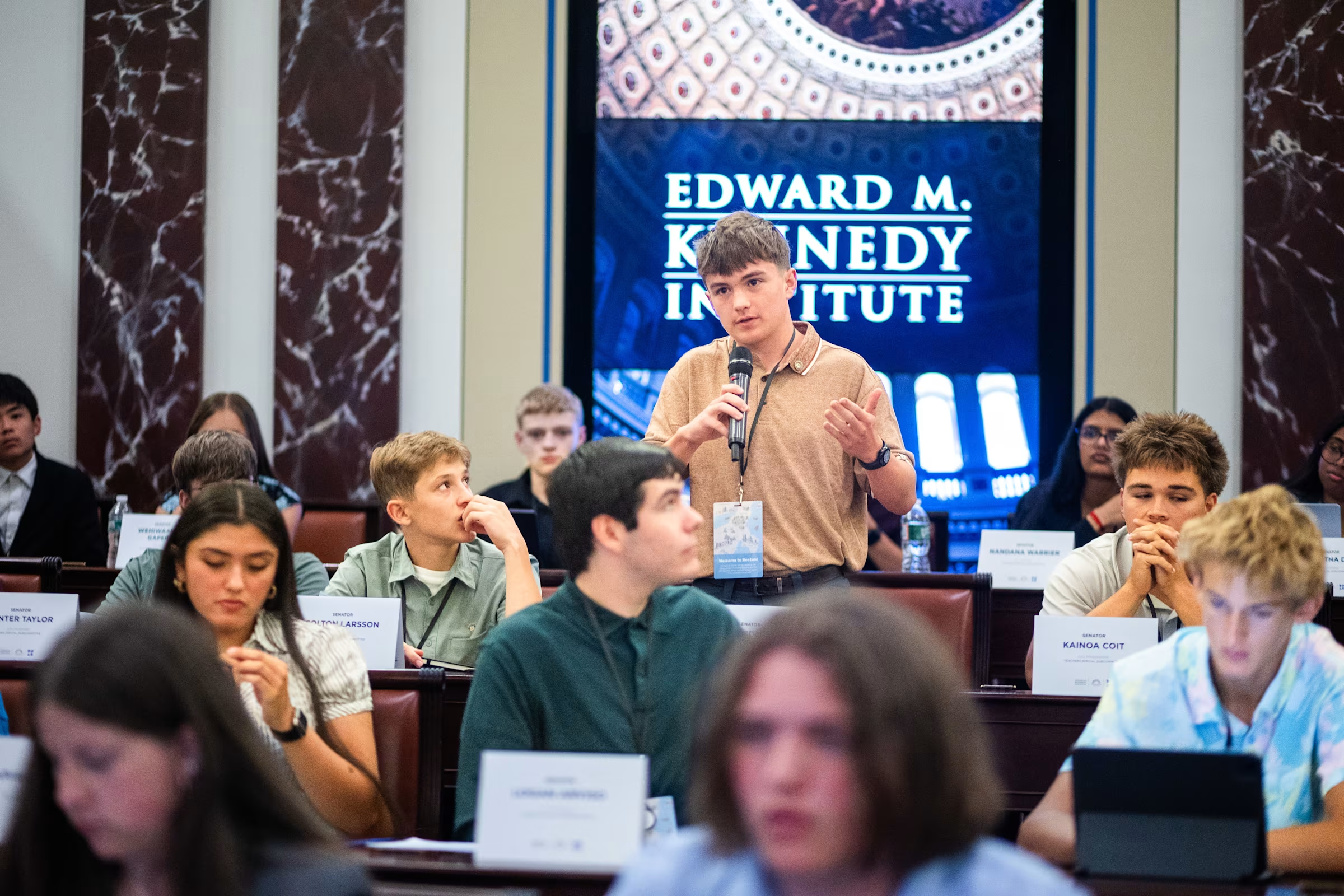
Students debate AI policy for schools at the Day of AI
Credit: Eric Haynes/Edward M. Kennedy Institute
Adults from seemingly every corner of society are weighing in on artificial intelligence policies in the classroom. But what do students have to say about it?
A recent event offered some clues, as student leaders from around the nation proposed a set of national guidelines for the use of AI in schools at the America’s Youth AI Festival in Boston. The three-day event brought together student leaders, educators, and school system leaders from across the country to discuss acceptable AI use in schools.
The event was hosted by Day of AI, MIT RAISE, The School Superintendents Association (AASA) and the Edward M. Kennedy Institute. The festival concluded with “student senators” from across the country debating a first-of-its-kind national AI policy for K-12 classrooms.
At the end of three hours of lively debate, student senators framed a multi-faceted bill that will be presented to the 10,000 member-districts in the AASA for further discussion and debate. Transparency, literacy and security were among its key provisions, and the goal is that the student-created regulations will inspire adult leaders to act in similar fashion.
“We hope the STUDENTS First Act becomes a practical starting point for policymakers, school systems, educators and families, rather than a finished piece of legislation to be adopted word for word,” says Dan Rae, head of business development and strategy for Day of AI. “In the coming weeks and months, our combined team plans to share the policy with school leaders nationwide, gathering feedback through webinars and other discussions, and giving students opportunities to continue refining and advocating for their recommendations.”
Jeffrey C. Riley, executive director of Day of AI and former Massachusetts commissioner of elementary and secondary education, and Sarah Yezzi, chief education officer at the Edward M. Kennedy Institute, were the facilitators of the debate. Student and educator representatives from Alaska, Florida, Hawaii, Kansas, Maine and Massachusetts participated, offering perspectives on both the opportunities and challenges artificial intelligence presents in today’s classrooms.
The Need for Student Involvement
The students identified a number of areas of concern for young people using AI: academic integrity and cheating; compromised learning and critical thinking; and threats to privacy, security and mental health. Students were concerned about AI being used to create false images or deepfakes of themselves or classmates that could then circulate rapidly online or within the school community. They agreed these are areas that need regulation.
“Several emphasized the importance of expanding equitable access to AI tools and resources, particularly for students who may lack support outside of school,” Yezzi explains. “Others raised concerns about overreliance on AI, the need to preserve critical thinking skills, and the importance of teaching students how to use AI effectively through strong prompting and digital literacy. Participants also discussed the need for thoughtful policies and infrastructure to support responsible implementation in schools.”
As federal and state lawmakers address the call for tighter regulations around artificial intelligence, the student leaders hope that their policy adoptions will help shape clear and consistent AI policies that reflect the experiences and priorities of students themselves.
Experiencing the Wide Range of AI Policies
Among the school leaders participating was Molly Kensy, principal of Tech High School, in St. Cloud, Minnesota. She attended with two student leaders: senior Jiech Jeich and junior Bihmanji Acho. All three were looking to learn how AI policies are developed in other communities and share their recommendations.
“Our students were able to represent our state and school district. We were able to share our current district and state work around AI,” Kensy explains. “As an administrator, I have been able to network and learn from other states about what they are focusing on regarding AI literacy and supporting educators through this rapid change.”
Acho says he wished he had more time to speak with fellow senators, as everyone had unique perspectives on the task at hand. His role on this committee was to amend, strike, and debate policies throughout the bill, especially with his fellow administrative senators.
“Everyone I spoke to was essentially on the same page; we need AI policy now,” Acho says. “We all just had different ways we wanted to go about it. Some knew more about how it affected children. Some looked more into the environmental impact. Some even had knowledge on AI accuracy rates. We all had our vast knowledge, but throughout the conference we were able to conjoin our knowledge from different scopes to aid one another in our policymaking.”
Using a Senate Format for Effective Exchanges
The Kennedy Institute team designed the AI policy debate program to resemble a Senate session, allowing students to discuss, debate and vote on their policy proposals for the use of AI in K-12 schools. Students worked in subcommittees, produced and voted on amendments, and engaged in floor debate. The final debate on Sunday was followed by a roll call vote.
The students brought their own experiences with AI usage to the debate and discussed a range of ways in which their schools are approaching policy. Some communities are drafting or have adopted policies, many have uneven access to AI tools and unclear guidance, and some schools have banned the use of AI altogether.
A majority of student senators acknowledged that the bill is not perfect, but it is an important first step in AI regulation, Yezzi explains. The conversation was less about the pros and cons of AI itself, and more about the pros and cons of different methods of regulation and how far to go.
Riley emphasized that students should play a leading role in shaping how AI is used in education, describing the initiative as an opportunity to better understand how young people view AI and how it can be implemented responsibly.
“For decades, we’ve treated technology in education like a silver bullet, believing that if we just put a laptop in every student’s hands, learning would transform. It never did,” Riley says. “AI is different. It gives us the ability to personalize and differentiate learning for every student in ways that were never before possible.”
Recommendations That Garnered Strong Support
Acho and Jiech say some debated proposals got especially strong support among student senators.
“The first recommendation that caught my ear was proportional funding for every district, with a baseline minimum to limit economic disparities with AI. This amendment got a lot of my support,” Jiech says.
In the student section of the bill, student senators were tasked with finding the age at which schools should start integrating AI into classrooms. They decided that students should not use AI independently before ninth grade.
In a third recommendation, it was decided that students should also begin AI literacy in grades K-5. That was a point that Kensy also stressed, saying schools must learn to be adaptive as they develop thoughtful ways to educate young people and support educators as rapid change is happening.
“The last recommendation that stood out to me was a provision outlining federal funding,” Acho says. “This was one of the rare moments throughout the debating and brainstorming where I saw other senators thinking about accessibility. Their provision made various clauses in the bill a real possibility for underfunded and underprivileged communities.”
A ‘Not Perfect’ Bill Emerges
At the end of the debate, the bill was passed through the student senate, which Jiech calls “a really great stepping stone as we continue to navigate our way through this very new technology.”
The majority of the students acknowledged the need for more guidelines for the use of AI, citing personal safety, data privacy and environmental impact as areas that need to be regulated. Several students focused on the potential of AI tools and the need for the U.S. to be competitive in the global economy, though there was a sense that there should be guardrails.
They also saw the potential benefits of AI for brainstorming, research and self-directed learning, Yezzi explains. Most of the students did not want to prohibit AI usage as a whole or inhibit technological innovation. But they want to see AI responsibly incorporated into education for themselves and future students as the technology develops.
Rae explains that one of the biggest surprises was how strongly the students emphasized protecting authentic learning while still allowing thoughtful uses of AI. The bill would prohibit students from using AI to produce written or artistic assignments, while allowing older students to use it — with teacher permission and disclosure — for activities such as brainstorming, studying and editing their own work.
The students also notably emphasized fairness and due process: schools should not rely solely on AI-detection software, and students accused of misuse should have access to human review and an appeals process.
“We weren’t necessarily surprised by the students’ thoughtfulness and level of nuance, but we definitely appreciated their ability to adroitly navigate difficult tensions inherent in these questions,” Rae says.
Popular on EdSurge
News
Hundreds of Thousands of Eligible Kids Are Waiting for Childcare Assistance
Moriah Balingit and Lauren CoffeyNews
A Principal and a Student Reviewed the New ChatGPT for Teens. They Had Plenty to Say
David WeldonRead Next


Educator Commentary
Artificial Intelligence
I Used AI to Build AI-Resistant Assignments

News
EdSurge Podcast
Two Students, Two Questions They Wouldn’t Let Go

News
Visual Arts


Voices of Change
Artificial Intelligence

News
EdSurge Podcast
What Happens When AI Policy Meets a Real Classroom?

Voices of Change
Artificial Intelligence