I Built the Chemistry Platform I Needed in My Own Classroom
What would chemistry look like if students could do more than read about it?
July 9, 2026
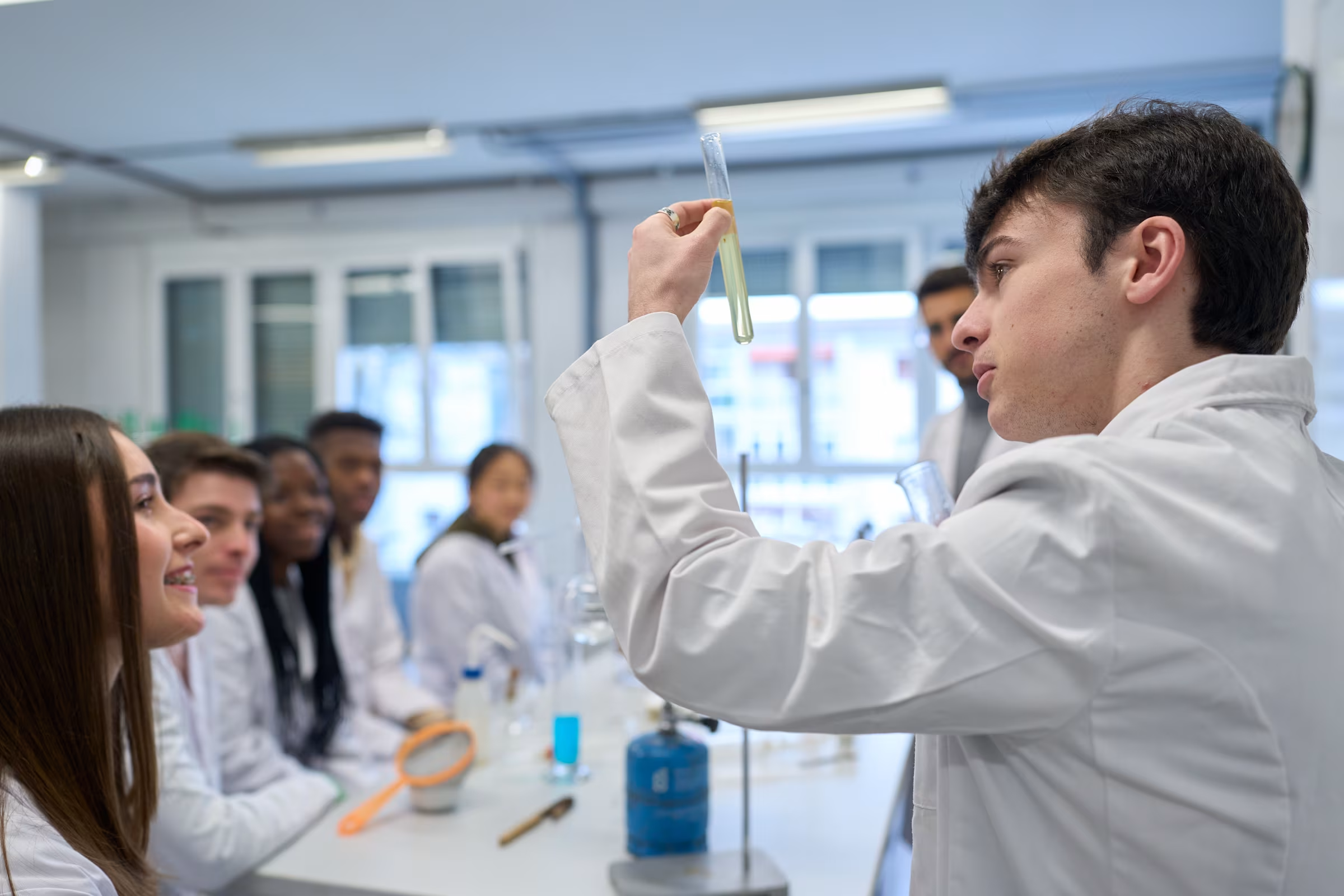
Credit: alvarog1970 / Shutterstock
As a current high school student, the first thing I noticed about chemistry was that it was not only hard because of math or vocabulary. It was hard because so much of it was invisible.
In class, I could write a chemical formula. I could memorize that a molecule had a certain shape or that a reaction moved in a certain direction. But much of chemistry did not feel like something I could touch, move, test, or explore. The most important parts happened in a way I would never see.
A Two-Dimensional Perspective
Chemistry is a subject built on relationships. Atoms connect, electrons move, bonds form, molecules bend, acids and bases shift equilibrium, gases respond to pressure and temperature, and reactions balance because matter must be conserved. When those ideas stay flat on a page, students memorize answers without understanding the system behind them.
As a rising 12th-grade student at Suitland High School in Prince George’s County, Maryland, I set out to build a solution because I wanted a serious chemistry workspace students like me could use. I wanted something visual and interactive that could run on school devices without complicated setup — without the need for students to create accounts, download resources, or collect student data. I also wanted something that could open in a browser and allow students to begin learning right away.
Atomency started from a simple question: What would chemistry look like if students could build, manipulate and test ideas instead of only reading about them?
I began by building a workspace where students could create molecules and see structure-based information. From there, I added VSEPR-style analysis so students could connect formulas to molecular geometry instead of treating shapes as something to memorize from a chart. Then I kept expanding it: I incorporated reaction simulations, nuclear decay tools, kinetics tool, acid–base and pH tools, gas-law models and assignment workflows to help teachers bring the platform into the classroom.
I built all of this independently while still being a high school student. That meant I was not just designing a product in theory; I was building from inside the problem. I knew what it felt like to sit in a classroom and need a better way to see what was happening. I knew what it felt like when a concept almost made sense, but the missing piece was the ability to interact with it.
A Three-Dimensional Solution
Students usually receive educational tools instead of imagining or creating them. But students notice things adults can miss. We notice when a website is too slow on a school Chromebook. We notice when a platform requires an account before we can try it. We notice when a tool looks impressive in a presentation but does not align with the way a classroom actually works.
Access shaped how I built Atomency. A chemistry platform should not require expensive software or perfect devices. It should not require students to provide personal information. It should not assume all students have tutors, can pay to access resources, and have personal laptops powerful enough to run advanced programs. If a tool is meant to help students, it should reflect students’ reality.
For me, that reality was a public school classroom where students needed more ways to understand chemistry. Chemistry can become a gatekeeping subject. If students fall behind early, later topics become harder because everything builds on earlier ideas. Atomic structure connects to bonding. Bonding connects to molecular geometry. Geometry connects to polarity. Reactions connect to stoichiometry and equilibrium. Once one link in that chain breaks, the whole subject can start to feel impossible.
I wanted Atomency to help repair those links by making the relationships clearer. Instead of only telling students that a molecule has a certain shape, the platform can help them see how structure connects to geometry. Instead of only practicing reaction-balancing in steps, students can work with reactions as systems. Instead of treating acids, bases, gases, kinetics and nuclear decay as separate units, students can see chemistry as a connected field where patterns repeat in different forms.
Early usage showed me that students and teachers were looking for a platform like this. Atomency’s aggregate GoatCounter analytics indicated 25,162 visits from Feb. 24 to May 24, 2026, with strong engagement in the builder and simulations, the molecular workspace where students can create molecules and see structure-based information. This mattered to me not because it made the platform look popular but because it showed that people were using the parts of the platform that matched the original reason I built it: to give students a place to experiment with chemistry visually.
Atomency has been featured by Eric Curts in Control Alt Achieve and mentioned by Middle School Matters. My AP Chemistry teacher, Dr. Glenn Soltes, described the platform as having meaningful instructional potential. These moments helped me understand that the platform was not just something I made for myself. Other educators could see value in it too.
Still, the biggest lesson I learned was that students should be taken seriously as designers of learning environments. We are close to the problems because we experience them every day. When students say a tool is confusing, inaccessible, slow or disconnected from the way they learn, that feedback is not a complaint. It is design information.
Educational technology should not only be built for students but also with students and by students. That does not mean every student must become a software developer. It means schools and education companies should recognize that students have insight, creativity and lived experiences that can improve tools inside real classrooms.
I built Atomency because I needed a better way to learn chemistry. But as the platform grew, it became about something larger than my own classroom. It became a way to ask what happens when a student is trusted not only as a learner but also as a builder.
Chemistry became easier for me to understand when I could make it visible. Maybe school technology can become better when student experience becomes more visible too.
Popular on Edsurge
News