Why Would Anyone Opt for Virtual Kindergarten?
As a researcher, I knew the evidence. As a father, I learned that when making decisions for your child, emotions matter as well.
By Mi Aniefuna
July 31, 2026
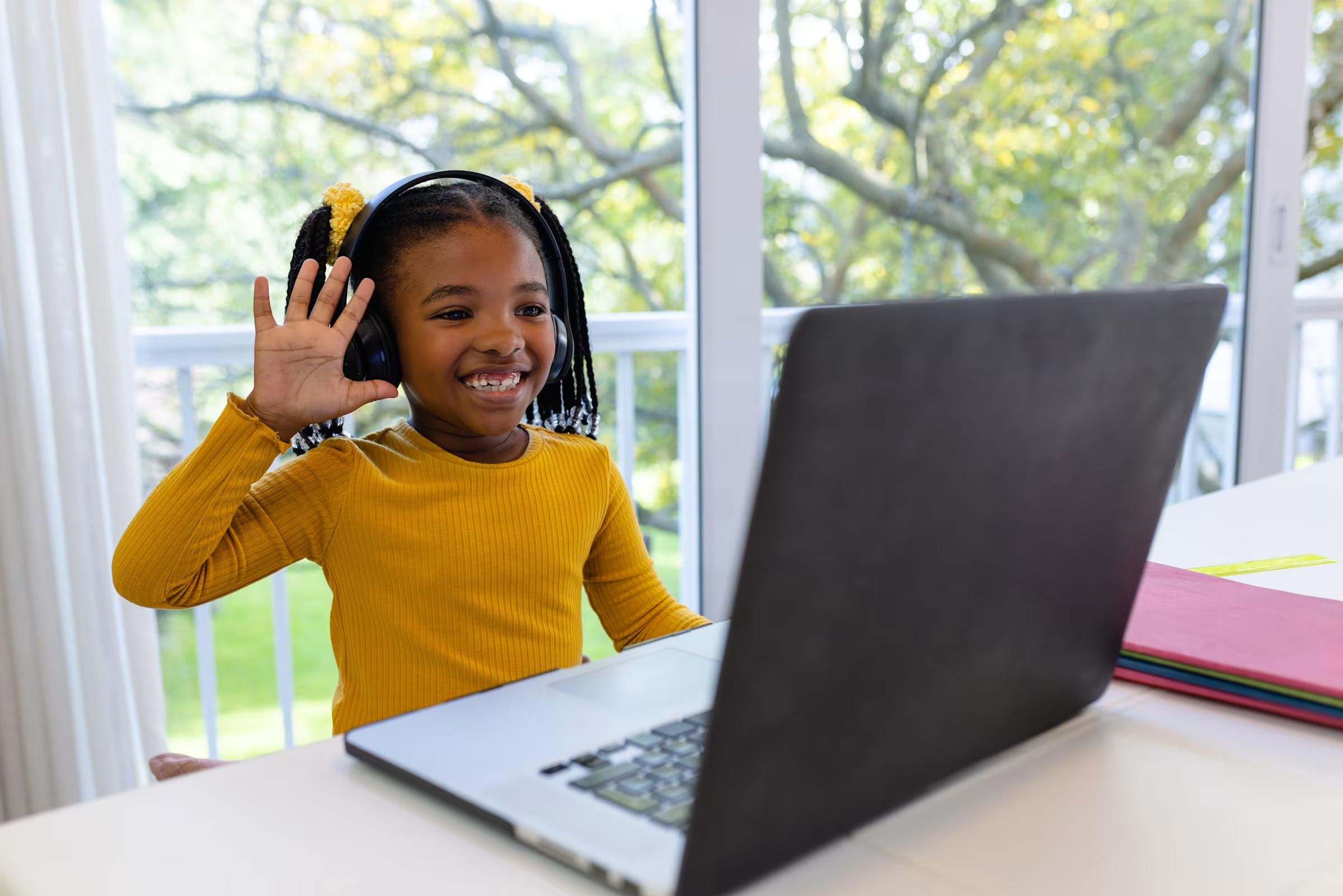
Credit: wavebreakmedia / Shutterstock
This fall, my daughter will attend kindergarten virtually. My theory is that she’ll actually have less screen time. My wife and I have been going back and forth about where to send her for school (and what type of school) for the past couple of years. My wife always envisioned curating our children’s learning environment from the comfort and safety of our home. The first time I heard it, I shrugged it off — happy wife, happy life. Sure, yep. We’ll deal with it when the kid turns five. But the kid has now turned five, and kindergarten has arrived.
I was a latchkey kid. Born and raised in the mean streets of Trenton, New Jersey, I grew up walking to school as early as kindergarten before being shipped from gifted and talented to private school — I got in one little fight and my mom got scared and said, “You’re going to that good private school in Bucks County in Pennsylvania.” Because of this incident, I’ve always been a proponent of social learning. My way of schooling taught me independence, conflict resolution, consistency, and resilience.
Virtual school, especially for early elementary, is still statistically uncommon. But after the COVID-19 pandemic school shutdowns between 2020 and 2021, the numbers of homeschool and virtual school students continues to rise. The National Center for Education Statistics estimates in its 2023 Parent and Family Involvement Survey that the percentage of students who received instruction at home increased from 3.7 percent before the pandemic to 5.2 percent during the 2022-23 school year. That’s approximately 1.7 million students between the ages of 5 and 17. The NCES, however, acknowledges that this number is difficult to consistently accurately measure across multiple years.
Anecdotally, I often talk to other parents and friends who are also busy chasing toddlers around grocery stores and playgrounds about how we choose our children’s educational and social environments. Regardless of what type of schooling they choose, most parents I come across significantly weigh the tradeoffs and put a lot of thought into these decisions. Sometimes we end up commiserating over our shared fears and worries that we’re making the right decisions for our children.
I watched my niece attend kindergarten from a screen, saw her social life diminish to a dozen Zoom boxes, and observed her generation’s growing reliance on social media for connection. I remember how hands-on we had to be to keep her learning consistent. She also received direct instruction from multiple adults, so she learned to quickly correct writing the letter “e” backward and to write in a straight line. She also finished up her year of dance classes on Zoom, and I remember the teacher’s frustration of trying to teach six-year-olds a proper pas de bourrée online.
So much of Gen Alpha and Gen Z came of age on a screen. Some of their most important moments of adolescence were facilitated in a virtual environment. There is a flurry of data showing the negative consequences of the generation of COVID kids. Knowing all of this, we still decided on virtual kindergarten anyway.
What convinced me to suspend my judgment and assumptions about homeschooling and virtual schooling is that the difference between then and now is that the world is no longer shut down. Virtual school will be one of several components of my daughter’s academic and social learning environments. But that doesn’t fully alleviate my parental anxiety, especially since it’s difficult to forget concerns of school safety, cultural belonging, and bullying. According to the NCES, these are amongst the frequently cited concerns amongst parents who chose home-based instruction.
My first thought about virtual school was that my daughter would be looking at a screen all day. Of my three children, my oldest is the screen monster. The latest American Academy of Pediatrics guidance on quality screen time suggests that its recommendations should be applied in the context of the child’s general reaction to screen time. And she is the one who concerns me most because she seems most cognitively sensitive to television, edtech, and most screens, in general.
School is Just One Component
One of the first theories I learned in behavioral science was Urie Bronfenbrenner’s ecological systems theory of human development. School is one of several places that facilitates social learning. It’s arguably where children spend the most time throughout their childhood, but it is part of the microsystem in a child’s life. Other components influence who they become.
Being Team Traditional School, I feared that without the brick-and-mortar school as the source of consistency and a cohort of other children she’s matriculating with, my daughter might miss out on what occasional drop-in gymnastics or library read-alouds can’t offer. What was missing from her pre-K homeschool education was the camaraderie growing up within a community, so I worried she might not develop the muscle of navigating evolving friendships over time, and eventually fail to learn to resolve the inevitable adolescent and preteen conflicts as they arise. There are few challenges in adolescence that show you who you are than when you’re faced with friendship breakups and makeups in chattery lunchrooms.
My cinematic imagination has played out so many scenes of my precious baby girl being unbearably socially anxious, curled up in her college dorm twin bed, because she's overstimulated by the campus dining hall. But I’ve had to calm my own anxiety and drop the dramatics and biases.
Trade-offs and Gaps
Consistent with Bronfenbrenner’s theory, we’ve decided on ways to tend to the various trade-offs and potential gaps of virtual school. Careful not to overcorrect, we’ve chosen developmentally appropriate extramural activities for the year, such as dance and other physical activities that she seems drawn to, and a culturally affirming youth auxiliary club. And we’ll continue organizing playdates and building routines and traditions around family, community, and cultural learning.
Am I ignoring the science of learning and the techlash debate? Yes and no, but mostly, no. Like most parenting decisions, there is no perfect answer or choice. There are trade-offs to traditional school, virtual school, and homeschool. There will be high- and low-quality screen time involved with each, because teaching and technology are enmeshed in ways that both aid and challenge learning. As parents, we simply cannot optimize every environment our children inhabit. Instead, we can be intentional about the totality of our children’s experiences and how those memories age as our children do.
Popular on Edsurge
Voices of Change