AI Videos Are Warping Early Learning, Teachers Say
The rise of so-called “baby slop” is turning early childhood educators into media critics.
By Adam Stone
September 8, 2026

Credit: christinarosepix / Shutterstock
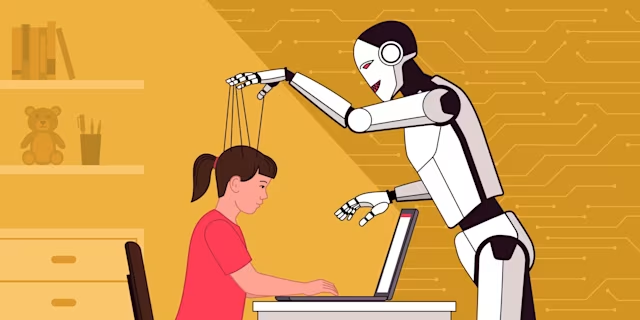
The internet is increasingly awash with videos generated by artificial intelligence aimed directly at preschoolers and kindergartners. With literally hundreds of thousands of AI-generated videos to watch and plenty of lights and action to grab the attention of children under age 5, critics say the videos usually have little if any substance. They also have a name for these videos: “baby slop.”
“It’s easy to make an eight-second AI video, and we wind up with these very quick, colorful, fun things that don’t really have any meaning,” says Allison Bacon, coordinator of instructional technology at the Ossining Union Free School District in New York.
More than mere distraction, some critics worry AI-generated content on YouTube and YouTube Kids may cause actual harm. But there are ways early childhood educators can help children navigate these videos.
Inaccurate and Biased Content
Problematic AI-generated videos come in many forms. Some are just seconds in length but include inappropriate content. In one video about counting and colors, for example, a school bus inexplicably bursts into flames at the 13-second mark. In other videos, inaccurate information or visuals are hallucinated by low-grade AI. Sometimes, it’s just the sheer volume of unvetted AI videos populating feeds that can be concerning. One YouTube channel, Bright Tunes, has existed for less than a year but has nearly 5,500 AI-generated videos. In effect, one person can prompt AI to generate thousands of videos that young children can watch in an endless loop — none of which are educational. While some creators have good intentions, they often just want views (cue cute AI animals diving into pools).
“Some of the content may look educational and engaging,” says Jennifer Chen, a professor of early childhood education at Kean University in Union, New Jersey. “You might not realize it unless you really look at it closely.”
When the words aren’t quite right or when the images don’t reflect reality, “that cognitive disparity is causing children to learn inaccurately,” explains Keri Ewart, an associate professor of education at Wilfrid Laurier University in Waterloo, Ontario. “It is having detrimental effects on children being able to understand the difference between real and fake.”
Repeated viewing may also damage kids’ attention spans and lead to cognitive overload. With preschool and kindergarten learners, “they’re still building neurological processes. They’re learning how to experience the world,” instructional technology coordinator Allison Bacon says. “Entertainment generated through AI to mindlessly babysit small people is inherently problematic.”
Navigating the Content
Teachers can address the problem by becoming ad hoc media critics, vetting everything their young students watch in the classroom. Beyond previewing videos, teachers should research the creator to gain more context. One sure sign that a YouTube channel is populated with AI-generated content is if it has a recent launch date and an outsize number of videos. Another telltale sign of AI slop: jumbled text and misspelled words.
Relying on trusted resources like Common Sense Media can help educators vet content. Also, the American Academy of Pediatrics recently released a guide for parents with a “Stop, Wait, Go” framework that can be adapted to the classroom.
If students do encounter suspect content, in ads for example, “conversation needs to follow,” Bacon explains. “What did we see? What did we think? The human connection and conversation should be the main focus.”
Even with very young kids, teachers can build decoding skills to recognize AI-generated content. “Really push the fact that we have to be thinkers and we have to be looking with that critical lens. Ask kids, ‘What did we notice? What’s good? What’s different?’” Bacon says.
“Be the person who helps them understand what they are seeing,” Bacon adds. “If they see an AI-generated giraffe, show them pictures of a real giraffe and ask them to describe the differences.”
Finally, even if one video is educationally sound or age appropriate, the algorithms may bring up more videos that could be inappropriate. “Never rely on autoplay, which can be easy to do, especially if you’re in the class and you’re already playing something that’s educational,” Bacon cautions.
Supporting Parents’ Efforts
As a preschool language teacher at the Park School in the Ossining Union Free School District and as a parent herself, Josefa Martinez understands that parents need guidance, too.
She sends home weekly and monthly communications to families with best practices. “I try to find websites and resources they can use at home, videos that I have personally watched and that are interactive, engaging,” she says. “These sites are not just promoting a child to sit and just mindlessly watch. It’s something that I can vouch for.”
Beyond video suggestions, Martinez provides parents with follow-up questions for their kids. If the child is watching a video about a firefighter, parents can ask, “How can a firefighter support our community?” or “What are other community helpers who have similar roles to a firefighter?” If the child is watching a video about numbers, on a channel like Numberblocks, parents may ask, “How do you know that five is bigger than two? Can you show me by using some of your toys?” or “How many ways can we make the number five?”
“These questions make sure the child is actually engaged and not just sitting there mindlessly watching,” Martinez says. “It all pertains to the content that I’m teaching either that week or that month.”
Some school leaders are stepping up as well, convening parents for frank discussions about AI-generated videos. “More schools are starting to have social media nights and AI evenings where they’re inviting parents to really learn how to vet these videos,” education professor Keri Ewart explains.
“This is all fairly recent for everyone,” Ewart adds. “If we’re expecting our children to have digital fluency and digital literacy, particularly in the age of AI, we’re going to have to expect teachers and parents to be digitally literate too.”
Popular on EdSurge
Read Next

Voices of Change
Artificial Intelligence

Voices of Change
Artificial Intelligence
Why AI Made Me a Better Principal
Voices of Change
Artificial Intelligence